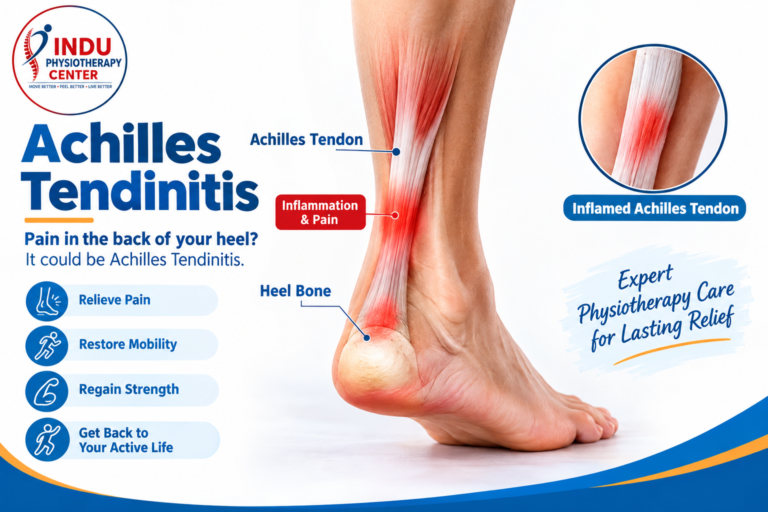
Achilles Tendinitis is a common overuse injury that affects the Achilles tendon, the strongest tendon in the human body. It connects the calf muscles to the heel bone and helps in walking, running, jumping, and climbing stairs. When this tendon becomes irritated or inflamed due to excessive stress, it can cause pain, stiffness, and swelling around the back of the ankle.
At Indu Physiotherapy Clinic, Gurgaon, we provide evidence-based Achilles Tendinitis physiotherapy treatment designed to relieve pain, restore flexibility, strengthen the tendon, and help patients return to daily activities and sports safely.
This condition is commonly seen in runners, athletes, gym enthusiasts, and people who suddenly increase physical activity without proper conditioning.
Achilles Tendinitis is an injury caused by repeated stress or overuse of the Achilles tendon. It may develop gradually and worsen if ignored. Early physiotherapy can prevent the condition from progressing into chronic tendon damage or tendon rupture.
|
Type |
Description |
| Midportion Achilles Tendinitis | Pain occurs in the middle section of the tendon, usually 2–6 cm above the heel bone. |
| Insertional Achilles Tendinitis | Pain develops where the tendon attaches to the heel bone. |
Red highlighted area shows the Achilles tendon inflammation and pain location.
Several factors can contribute to Achilles Tendinitis:
Sudden increase in running or walking distance.
Tight calf muscles.
Poor footwear support.
Excessive sports training.
Flat feet or high arches.
Weak ankle and calf muscles.
Improper warm-up before exercise.
Age-related tendon degeneration.
Obesity causing increased tendon load.
You may experience:
Pain behind the heel.
Morning stiffness in the ankle.
Swelling around the Achilles tendon.
Tenderness when touching the tendon.
Pain during walking or climbing stairs.
Increased pain while running or jumping.
Reduced ankle flexibility.
Difficulty standing on tiptoes.
|
Symptoms |
What It May Indicate |
| Persistent heel pain | Ongoing tendon inflammation. |
| Swelling after activity | Overloaded Achilles tendon. |
| Morning stiffness | Reduced tendon flexibility. |
| Pain while running | Sports-related Achilles injury. |
| Difficulty walking | Moderate or severe Achilles Tendinitis. |
People at higher risk include:
Runners and marathon athletes.
Football and badminton players.
Gym-goers performing jumping exercises.
Dancers.
Middle-aged adults.
People with diabetes.
Individuals with flat feet.
At Indu Physiotherapy Clinic, diagnosis includes:
Medical history evaluation.
Pain assessment.
Walking pattern analysis.
Tendon palpation.
Range of motion testing.
Muscle strength evaluation.
Functional movement assessment.
Referral for ultrasound or MRI if required.
Our personalized treatment plan focuses on long-term recovery.
Ice therapy.
Therapeutic ultrasound.
TENS therapy.
Manual soft tissue release.
Dry needling (when appropriate).
Achilles tendon mobilization.
Calf muscle release.
Ankle joint mobilization.
Myofascial release.
Gastrocnemius stretch.
Soleus stretch.
Plantar fascia stretch.
Ankle mobility exercises.
Heel raises.
Eccentric heel drops.
Resistance band ankle exercises.
Single-leg balance exercises.
Walking correction.
Running biomechanics.
Sports-specific rehabilitation.
Balance training.
|
Exercise |
Benefit |
| Wall Calf Stretch | Improves calf flexibility. |
| Eccentric Heel Drop | Strengthens Achilles tendon fibers. |
| Seated Heel Raise | Improves calf muscle endurance. |
| Ankle Alphabet Exercise | Enhances ankle mobility. |
| Resistance Band Plantar Flexion | Builds ankle strength. |
| Single Leg Balance | Improves stability and coordination. |
|
Recovery Stage |
Expected Progress |
| Week 1–2 | Pain reduction and swelling control. |
| Week 3–4 | Improved flexibility and walking comfort. |
| Week 5–8 | Strength recovery and better mobility. |
| Week 8–12 | Gradual return to running and sports. |
Recovery depends on the severity of tendon injury and adherence to physiotherapy exercises.
|
Do’s |
Don’ts |
| Warm up before exercise. | Ignore persistent heel pain. |
| Wear supportive footwear. | Run through pain. |
| Stretch calf muscles daily. | Increase training suddenly. |
| Follow physiotherapist instructions. | Walk barefoot on hard surfaces. |
| Perform strengthening exercises. | Skip recovery days. |
Reduce your risk of Achilles Tendinitis by:
Increasing exercise intensity gradually.
Wearing proper sports shoes.
Stretching calf muscles regularly.
Strengthening ankle and calf muscles.
Maintaining a healthy body weight.
Avoiding excessive hill running initially.
We provide personalized rehabilitation programs for heel and ankle injuries.
Achilles Tendinitis Rehabilitation.
Heel Pain Physiotherapy.
Sports Injury Rehabilitation.
Ankle Sprain Rehabilitation.
Plantar Fasciitis Treatment.
Running Injury Physiotherapy.
Dry Needling Therapy.
Manual Therapy.
Exercise Rehabilitation.
Home Physiotherapy in Gurgaon.
We serve patients across Sector 46, Sector 45, Sector 47, Sector 38, Sector 39, Sector 40, Sector 49, Sector 50, Sector 51, Sector 52, Sohna Road, Malibu Town, South City 2, and Near Medanta Hospital, Gurugram.
Yes. Early physiotherapy helps reduce pain, improve tendon strength, and restore normal movement without surgery in many cases.
Mild cases may recover within 4–6 weeks, while moderate cases can take 8–12 weeks with consistent rehabilitation.
Gentle walking may be beneficial if pain is controlled, but prolonged walking during the painful stage should be limited.
Eccentric heel drops, calf stretches, heel raises, ankle strengthening, and balance exercises are commonly recommended.
If heel pain lasts more than a few days, worsens during walking or running, or swelling develops around the Achilles tendon, consult a physiotherapist promptly.
Achilles Tendinitis can affect your ability to walk, run, climb stairs, and participate in sports. Ignoring heel pain may increase the risk of chronic tendon damage. Indu Physiotherapy Clinic in Gurgaon provides comprehensive Achilles Tendinitis physiotherapy treatment using manual therapy, pain management techniques, stretching, strengthening, and functional rehabilitation to support a safe recovery and reduce the chance of recurrence.
Most oral emergencies relate to pain, bleeding, or thoracic pain and should be attended by a Physiotherapist.
We will send you a confirmation within 24 hours. Emergency? Call +91-9289 059 265
Most oral emergencies relate to pain, bleeding, or thoracic pain and should be attended by a Physiotherapist.