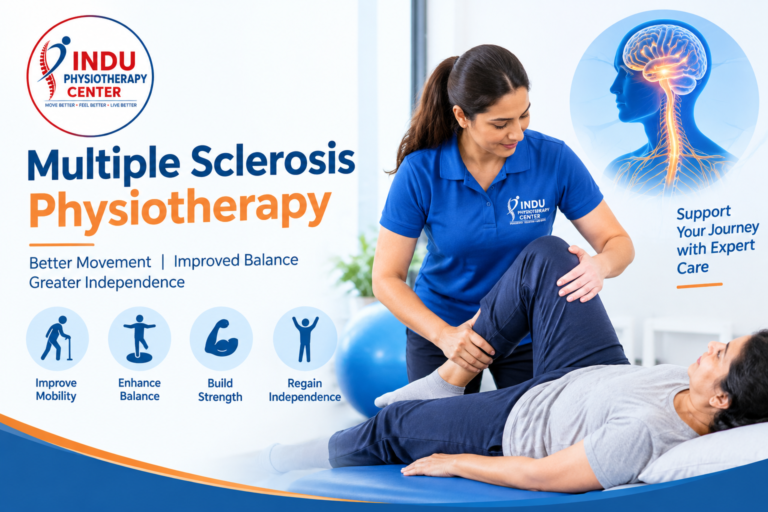
Multiple Sclerosis (MS) is a chronic neurological condition that affects the brain and spinal cord. It occurs when the immune system damages the protective covering (myelin) around nerve fibers, interrupting communication between the brain and the body. This can lead to muscle weakness, balance problems, fatigue, walking difficulties, numbness, and reduced coordination.
At Indu Physiotherapy Clinic, Gurgaon, we provide personalized Multiple Sclerosis Physiotherapy Treatment to improve mobility, strength, balance, posture, flexibility, and independence in daily life. Our rehabilitation programs are designed according to each patient’s symptoms and stage of recovery.
Multiple Sclerosis is an autoimmune neurological disorder where the immune system attacks the myelin sheath surrounding nerves. As the damage progresses, nerve signals become slower or interrupted, causing various physical and neurological symptoms.
| Type of MS | Description |
|---|---|
|
Relapsing-Remitting MS (RRMS) |
Episodes of symptoms followed by periods of recovery. |
|
Secondary Progressive MS (SPMS) |
Symptoms gradually worsen over time after RRMS. |
|
Primary Progressive MS (PPMS) |
Symptoms steadily progress without clear relapses. |
|
Progressive Relapsing MS |
Progressive disease with occasional relapses. |
The damaged myelin sheath disrupts communication between the brain and muscles.
Muscle weakness in arms or legs.
Difficulty walking.
Balance and coordination problems.
Numbness or tingling.
Muscle stiffness (spasticity).
Fatigue during daily activities.
Tremors.
Vision disturbances.
Difficulty maintaining posture.
Bladder and bowel dysfunction in some patients.
| Symptom | How Physiotherapy Helps |
|---|---|
| Walking Difficulty | Gait training and strengthening exercises. |
| Balance Problems | Balance and coordination training. |
| Muscle Weakness | Progressive strengthening exercises. |
| Fatigue | Energy conservation techniques and endurance training. |
| Spasticity | Stretching and muscle relaxation techniques. |
Autoimmune disorders.
Family history.
Vitamin D deficiency.
Viral infections.
Smoking.
Women are more commonly affected than men.
Young adults between 20–40 years.
Neurological examination.
MRI Brain and Spine.
Reflex assessment.
Muscle strength testing.
Balance and coordination evaluation.
Functional mobility assessment.
Every MS rehabilitation program is personalized according to symptoms and mobility level.
Gentle stretching.
Manual therapy.
TENS therapy.
Heat therapy where appropriate.
Soft tissue mobilization.
Weight shifting.
Single-leg balance (modified).
Tandem walking.
Stability exercises.
Functional balance activities.
Sit-to-stand exercise.
Bridging.
Resistance band exercises.
Hip strengthening.
Core strengthening.
Walking pattern correction.
Step training.
Stair climbing practice.
Assistive device training if needed.
Energy conservation education.
Breathing exercises.
Low-impact aerobic exercises.
Activity pacing techniques.
| Exercise | Benefit |
|---|---|
| Heel Raises | Improves calf strength and balance. |
| Bridging Exercise | Strengthens hips and core muscles. |
| Sit-to-Stand | Improves functional mobility. |
| Marching Exercise | Enhances coordination and hip strength. |
| Theraband Leg Exercise | Improves lower limb strength. |
| Balance Exercises | Reduces fall risk. |
Walk more confidently.
Improve posture.
Increase muscle strength.
Improve balance.
Reduce stiffness.
Improve endurance.
Reduce fall risk.
Perform daily activities independently.
| Rehabilitation Stage | Expected Improvement |
|---|---|
| Weeks 1–2 | Pain reduction, flexibility improvement, and muscle activation. |
| Weeks 3–4 | Better balance and improved walking pattern. |
| Weeks 5–8 | Improved strength and endurance. |
| Weeks 8–12 | Greater independence in daily activities and mobility. |
Recovery varies depending on disease progression and consistency with physiotherapy.
| Do’s | Don’ts |
|---|---|
| Exercise regularly under guidance. | Avoid complete inactivity. |
| Take rest between activities. | Overexert during fatigue. |
| Maintain hydration. | Ignore balance problems. |
| Stretch daily. | Skip physiotherapy sessions. |
| Use assistive devices if prescribed. | Walk on slippery surfaces without support. |
Neurological Physiotherapy.
Multiple Sclerosis Rehabilitation.
Balance Training.
Gait Training.
Strengthening Exercises.
Home Physiotherapy in Gurgaon.
Manual Therapy.
Functional Mobility Training.
Fall Prevention Rehabilitation.
Personalized Exercise Programs.
We serve patients across Sector 46, Sector 45, Sector 47, Sector 38, Sector 39, Sector 40, Sector 49, Sector 50, Sector 51, Sector 52, Sohna Road, South City 2, Malibu Town, and Near Medanta Hospital, Gurugram.
Yes. Physiotherapy helps improve balance, strength, flexibility, walking ability, and independence in daily life.
Physiotherapy may be modified depending on symptoms and medical advice. Gentle rehabilitation is often beneficial after assessment.
The frequency depends on the patient’s condition, fatigue level, mobility, and rehabilitation goals.
Yes. Stretching, manual therapy, positioning, and strengthening exercises help reduce spasticity and stiffness.
Yes. Gait training and balance rehabilitation help improve walking mechanics and reduce fall risk.
Multiple Sclerosis affects movement, coordination, strength, and balance, but early and consistent rehabilitation can significantly improve daily functioning and quality of life. Indu Physiotherapy Clinic in Gurgaon offers comprehensive Multiple Sclerosis Physiotherapy Treatment with personalized neurological rehabilitation, balance training, gait correction, strengthening exercises, and functional mobility programs to help patients stay active and independent.
Most oral emergencies relate to pain, bleeding, or thoracic pain and should be attended by a Physiotherapist.
We will send you a confirmation within 24 hours. Emergency? Call +91-9289 059 265
Most oral emergencies relate to pain, bleeding, or thoracic pain and should be attended by a Physiotherapist.