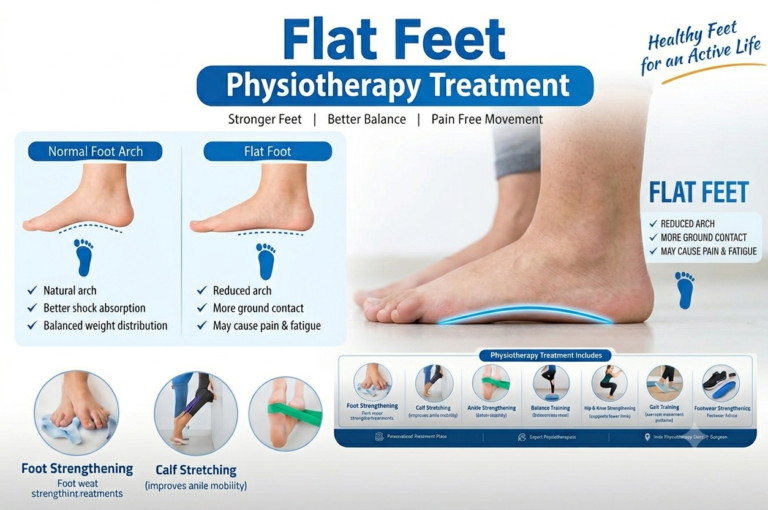
Flat Feet Physiotherapy Treatment in Gurgaon can help reduce foot pain, improve walking mechanics, strengthen the muscles supporting the arch, and restore better balance and lower-limb function. Flat feet, also known as pes planus, occur when the natural arch of the foot is reduced or collapses, causing more of the sole to come into contact with the ground.
Some people with flat feet have no symptoms, while others may experience foot pain, ankle discomfort, fatigue while standing, knee pain, or difficulty during walking and running. A physiotherapist can assess the foot, ankle, knee, hip, and walking pattern to identify contributing factors and develop an individualized rehabilitation program.
A healthy foot has a natural arch that helps distribute body weight and absorb forces during standing and movement. In flat feet, this arch is lower than usual and may become more pronounced when standing.
NORMAL FOOT FLAT FOOT
/ ______
/ /
_____/ ____ ____/ ____
↑ Arch ↑ Reduced /
Natural support collapsed arch
Better load distribution Increased foot contact
and shock absorption with the ground
Flat feet can be present from childhood or develop later in life due to muscle weakness, ligament problems, injury, prolonged standing, increased body weight, aging, or changes in foot biomechanics.
The foot is the foundation of the lower limb. When the arch collapses excessively, it can alter the alignment and movement of the ankle, knee, and hip.
Flat Foot
↓
Excessive Foot Pronation
↓
Altered Ankle Alignment
↓
Changes in Tibial Rotation
↓
Knee & Hip Movement Changes
↓
Muscle Overload
↓
Pain / Fatigue / Reduced Function
This does not mean that every person with flat feet will develop pain. Physiotherapy focuses on the individual’s symptoms, strength, mobility, posture, and movement pattern rather than treating the appearance of the foot alone.
Flat feet may cause no symptoms, but symptomatic cases can include:
Pain in the arch of the foot
Heel or ankle discomfort
Foot fatigue after prolonged standing
Pain while walking or running
Swelling around the inner ankle
Difficulty standing for long periods
Reduced balance
Tight calf muscles
Recurrent ankle discomfort
Knee or hip discomfort associated with altered lower-limb mechanics
Difficulty performing sports or physical activities
Children may also show unusual walking patterns, frequent tripping, reduced endurance, or difficulty keeping up with other children during physical activities.
Flat feet can develop for different reasons.
1. Natural foot development
Flat arches are common in young children because the arch may develop gradually as the child grows.
2. Weak foot muscles
Reduced strength of the intrinsic muscles of the foot can affect arch support.
3. Tight calf muscles
Limited ankle movement can influence foot mechanics during walking.
4. Ligament or tendon problems
Changes affecting structures that support the arch may contribute to acquired flat feet.
5. Foot or ankle injury
Trauma can change normal foot mechanics.
6. Prolonged standing or walking
Long periods of repetitive loading may aggravate symptoms in susceptible individuals.
7. Increased body weight
Higher mechanical loading can increase stress on the foot and ankle.
8. Poor lower-limb biomechanics
Changes in hip, knee, ankle, or foot movement may contribute to excessive pronation.
A physiotherapy assessment is important before starting a treatment program.
The physiotherapist may evaluate:
Foot posture
Arch height
Ankle mobility
Calf muscle flexibility
Foot and ankle strength
Balance
Walking pattern
Running mechanics when appropriate
Knee alignment
Hip strength and control
Functional activities such as squatting, stepping, and standing
Patient History
↓
Foot & Ankle Examination
↓
Muscle Strength + Flexibility
↓
Balance & Gait Assessment
↓
Lower-Limb Alignment Analysis
↓
Individual Physiotherapy Plan
Physiotherapy treatment is selected according to the person’s age, symptoms, foot structure, activity level, and functional limitations.
Strengthening the muscles of the foot can improve muscular support and control.
Common exercises may include:
Towel scrunches
Toe spreading
Short-foot exercise
Arch activation exercises
Heel raises
Controlled toe exercises
The exercises should be performed with proper technique and progressed gradually.
Tight calf muscles may restrict ankle movement and affect walking mechanics.
A physiotherapist may prescribe:
Gastrocnemius stretching
Soleus stretching
Wall calf stretches
Controlled ankle mobility exercises
Tight Calf
↓
Reduced Ankle Mobility
↓
Compensatory Foot Movement
↓
Increased Mechanical Stress
Calf Mobility
↓
Better Ankle Movement
↓
Improved Walking Mechanics
Strong ankle muscles help provide better stability during standing and movement.
Exercises may include:
Resistance-band ankle movements
Heel raises
Controlled single-leg exercises
Ankle stability drills
Functional balance exercises
Flat feet can sometimes be associated with reduced foot and ankle control.
Physiotherapy may include progressive balance exercises such as:
Double-Leg Balance
↓
Single-Leg Balance
↓
Dynamic Balance
↓
Functional / Sports-Specific Balance
Exercises are progressed according to the patient’s ability and safety.
Because foot mechanics can influence the movement of the entire lower limb, strengthening the hip and knee muscles may be included when weakness or poor movement control is identified.
Examples include:
Glute strengthening
Hip abductor exercises
Squats
Step-ups
Controlled lunges
Functional strengthening
The goal is to improve overall lower-limb movement rather than focusing only on the foot.
A physiotherapist can assess walking and running mechanics to identify excessive or inefficient movement patterns.
Treatment may include:
Walking retraining
Foot placement education
Balance training
Functional movement correction
Running technique modification when required
When clinically appropriate, manual therapy may be used to address mobility restrictions in the foot, ankle, calf, or surrounding joints.
It may be combined with active exercise to improve functional movement.
Appropriate footwear can improve comfort during daily activities.
Depending on the assessment, a physiotherapist may recommend discussing:
Supportive footwear
Appropriate shoe size and fit
Activity-specific footwear
Arch-support options
Orthotic assessment when clinically indicated
Orthotics are not automatically required for everyone with flat feet. Their use should be based on symptoms, functional needs, and professional assessment.
A customized exercise program may include:
| Exercise | Main Purpose |
|---|---|
| Short-Foot Exercise | Improve arch muscle activation |
| Toe Spreading | Improve foot control |
| Towel Scrunches | Strengthen intrinsic foot muscles |
| Heel Raises | Improve calf and foot strength |
| Calf Stretch | Improve ankle mobility |
| Resistance-Band Exercises | Improve ankle strength |
| Single-Leg Balance | Improve stability |
| Squats & Step-Ups | Improve lower-limb control |
Important: Exercise selection, repetitions, and progression should be individualized. Pain that is persistent or worsening should be assessed by a healthcare professional.
Flat feet are relatively common during childhood and do not always require treatment. In many children, the foot develops naturally as they grow.
Physiotherapy may be considered when a child has:
Persistent foot pain
Difficulty walking or running
Frequent tripping
Reduced balance
Muscle weakness
Activity limitations
Significant functional problems
Child Assessment
↓
Growth & Development Review
↓
Foot + Ankle Assessment
↓
Balance & Gait Analysis
↓
Strength & Flexibility Training
↓
Functional Play-Based Exercises
↓
Progress Monitoring
Adult flat feet may be longstanding or may develop over time. New or worsening symptoms—especially pain or swelling around the inner ankle—should be evaluated because tendon or ligament problems can sometimes contribute to acquired flatfoot.
Physiotherapy may focus on:
Pain management
Foot and ankle strengthening
Calf flexibility
Balance training
Walking mechanics
Lower-limb strengthening
Activity modification
Footwear advice
A structured physiotherapy program may help:
Reduce activity-related foot discomfort
Improve foot and ankle strength
Improve flexibility
Enhance balance and stability
Improve walking mechanics
Improve lower-limb movement control
Increase tolerance for standing and walking
Support a return to recreational or sporting activities
The results vary depending on the underlying cause, severity, age, symptoms, and adherence to the rehabilitation program.
Consider professional assessment if flat feet are associated with:
Persistent foot pain
Recurrent ankle discomfort
Difficulty walking or running
Reduced balance
Pain after prolonged standing
Repeated sports-related problems
A noticeable change in foot shape
New symptoms developing in adulthood
Functional problems in a child
Seek medical evaluation promptly after significant injury, severe swelling, sudden inability to bear weight, or rapidly worsening symptoms.
If you are looking for Flat Feet Physiotherapy Treatment in Gurgaon, an individualized physiotherapy assessment can help identify the factors contributing to your symptoms and movement limitations.
At Indu Physiotherapy, physiotherapy may include assessment of the foot and ankle along with the knee, hip, balance, gait, muscle strength, flexibility, and functional movement.
The rehabilitation plan can be tailored according to the patient’s age, symptoms, lifestyle, and activity requirements.
Physiotherapy may not permanently change the structural shape of every flat foot, but it can help improve strength, mobility, balance, movement control, and symptoms when these are contributing to functional problems.
Walking can be appropriate for many people with flat feet. However, if walking causes significant or persistent pain, the activity level, footwear, and underlying biomechanics should be assessed.
Strengthening exercises can improve muscular control and support around the foot. The amount of structural arch change varies between individuals.
Not every child with flat feet needs treatment. Physiotherapy is more relevant when flat feet are associated with pain, functional limitations, poor balance, weakness, or difficulty with age-appropriate activities.
Not everyone with flat feet needs orthotics. They may be considered when symptoms or functional requirements indicate a need for additional support.
The rehabilitation period varies according to the cause, severity, symptoms, age, strength, activity level, and consistency with the prescribed program.
FLAT FEET
│
▼
┌─────────────────┐
│ Physiotherapy │
│ Assessment │
└────────┬────────┘
│
┌────────▼────────┐
│ Identify Cause │
│ & Movement │
│ Problems │
└────────┬────────┘
│
┌────────▼────────┐
│ Foot & Ankle │
│ Strengthening │
└────────┬────────┘
│
┌────────▼────────┐
│ Calf & Ankle │
│ Mobility │
└────────┬────────┘
│
┌────────▼────────┐
│ Balance & Gait │
│ Training │
└────────┬────────┘
│
┌────────▼────────┐
│ Functional │
│ Rehabilitation │
└────────┬────────┘
│
▼
Better Foot & Lower-Limb
Movement Control
With an appropriate assessment and individualized exercise program, physiotherapy can help many people with symptomatic flat feet improve comfort, stability, movement quality, and participation in daily activities.
Related Physiotherapy Services: Pediatric Physiotherapy • Orthopedic Physiotherapy • Gait Training • Balance Rehabilitation • Sports Physiotherapy • Foot and Ankle Rehabilitation
Most oral emergencies relate to pain, bleeding, or thoracic pain and should be attended by a Physiotherapist.
We will send you a confirmation within 24 hours. Emergency? Call +91-9289 059 265
Most oral emergencies relate to pain, bleeding, or thoracic pain and should be attended by a Physiotherapist.