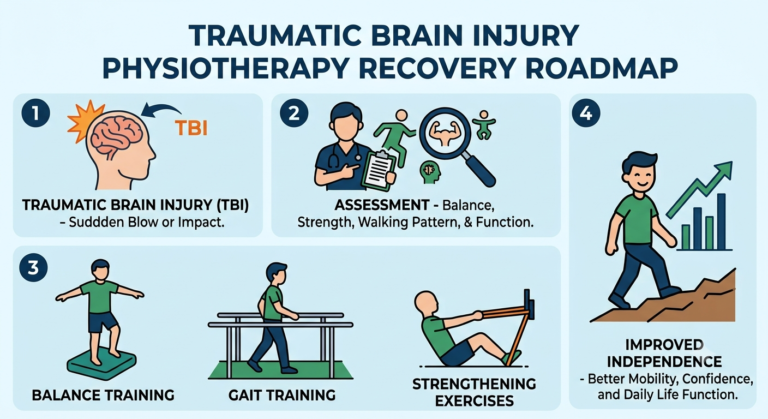
Traumatic Brain Injury (TBI) occurs when a sudden blow, jolt, or impact to the head damages the brain. It can happen due to road accidents, falls, sports injuries, workplace accidents, or physical trauma.
A traumatic brain injury may affect:
Brain function and thinking ability.
Muscle strength and coordination.
Speech and swallowing.
Memory and concentration.
Balance and walking.
Early physiotherapy rehabilitation helps improve recovery and reduces long-term disability.
|
Type |
Description |
| Concussion | Mild brain injury caused by impact or shaking of the head. |
| Contusion | Bruising of brain tissue due to direct trauma. |
| Diffuse Axonal Injury | Damage to nerve fibers caused by rapid movement of the brain. |
| Penetrating Brain Injury | Injury caused by an object entering the skull. |
| Hematoma | Collection of blood inside or around the brain. |
The most common causes include:
Road traffic accidents.
Falls in elderly people.
Sports injuries.
Workplace accidents.
Assault or physical trauma.
Bicycle or motorcycle accidents.
Falls in children.
Headache.
Dizziness.
Loss of balance.
Weakness in arms or legs.
Difficulty walking.
Fatigue.
Muscle stiffness.
Memory loss.
Difficulty concentrating.
Slow thinking.
Confusion.
Poor attention.
Anxiety.
Mood swings.
Irritability.
Depression.
Sleep disturbances.
Seek immediate medical attention if the patient has:
Loss of consciousness.
Repeated vomiting.
Seizures.
Difficulty speaking.
Severe headache.
Unequal pupils.
Physiotherapy is essential during every stage of brain injury recovery.
Step 1
Brain Injury
Trauma affects movement, balance, strength, speech, and coordination.
Step 2
Neuro Physiotherapy Assessment
Muscle strength, balance, walking pattern, reflexes, posture, and functional abilities are evaluated.
Step 3
Personalized Rehabilitation Program
Strength training, balance training, gait training, coordination exercises, and functional mobility practice.
Step 4
Improved Independence
Better walking, improved balance, stronger muscles, safer daily activities, and enhanced quality of life.
|
Physiotherapy Treatment |
Benefits |
| Balance Training | Reduces falls and improves stability. |
| Strengthening Exercises | Builds muscle strength and endurance. |
| Gait Training | Improves walking pattern and confidence. |
| Functional Training | Helps perform daily activities independently. |
| Coordination Exercises | Enhances hand-eye and body coordination. |
| Posture Correction | Prevents muscle stiffness and improves alignment. |
Our neuro physiotherapist evaluates:
Muscle strength.
Range of motion.
Balance and coordination.
Walking ability.
Posture.
Functional mobility.
Reflexes.
Spasticity.
Pain level.
This assessment helps create an individualized rehabilitation plan.
Improves:
Standing balance.
Walking balance.
Dynamic stability.
Confidence during movement.
Single-leg standing.
Weight shifting.
Tandem walking.
Balance board exercises.
Helps patients:
Walk safely.
Improve step length.
Increase walking speed.
Reduce fall risk.
Techniques include:
Parallel bar walking.
Stair training.
Walker or cane training.
Treadmill gait training.
Focus on strengthening:
Legs.
Arms.
Core muscles.
Shoulder muscles.
Exercises include:
Sit-to-stand.
Mini squats.
Heel raises.
Resistance band exercises.
Improves:
Hand movements.
Foot placement.
Eye-hand coordination.
Daily functional tasks.
Includes:
Bed mobility.
Sitting balance.
Standing practice.
Chair transfers.
Toilet transfers.
Helps reduce:
Muscle tightness.
Joint stiffness.
Contractures.
Pain.
Useful for patients experiencing:
Vertigo.
Dizziness.
Poor balance.
Motion sensitivity.
|
Recovery Stage |
Physiotherapy Goals |
| Acute Stage | Prevent stiffness, maintain breathing, positioning, passive exercises. |
| Early Rehabilitation | Sitting balance, standing, transfers, mobility training. |
| Recovery Stage | Walking, strengthening, coordination, endurance exercises. |
| Community Rehabilitation | Return to work, sports, driving, and independent activities. |
|
Exercise |
Purpose |
| Bridging | Strengthens hips and core muscles. |
| Heel Slides | Improves knee and hip movement. |
| Seated Marching | Enhances coordination and hip strength. |
| Standing Heel Raises | Improves calf strength and balance. |
| Wall Squats | Builds lower limb strength. |
| Step-Up Exercise | Improves walking and stair climbing. |
Always:
Perform exercises under professional supervision initially.
Avoid overexertion.
Monitor dizziness or fatigue.
Use walking aids if prescribed.
Stay hydrated.
Progress exercises gradually.
At Indu Physiotherapy Clinic, Gurgaon, we offer:
Neuro Physiotherapy Rehabilitation.
Brain Injury Recovery Programs.
Stroke Rehabilitation.
Balance & Gait Training.
Vestibular Rehabilitation.
Strength & Mobility Training.
Home Physiotherapy Services in Gurgaon.
Personalized Recovery Plans.
Functional Movement Training.
Core Stability Exercises.
Proprioceptive Training.
Coordination Rehabilitation.
Posture Correction.
Manual Therapy.
Electrotherapy (when clinically indicated).
|
Recovery Period |
Expected Progress |
| 1–4 Weeks | Pain management, positioning, early movement. |
| 1–3 Months | Improved balance, walking, and strength. |
| 3–6 Months | Better coordination and independence. |
| 6–12 Months | Advanced functional recovery and return to daily life activities. |
Recovery varies depending on injury severity, age, and rehabilitation consistency.
Start physiotherapy as early as medically advised.
Exercise regularly.
Maintain proper nutrition.
Sleep adequately.
Stay mentally active.
Follow the physiotherapist’s home exercise program.
Attend scheduled rehabilitation sessions.
Yes. Physiotherapy is one of the most important treatments for improving mobility, balance, muscle strength, coordination, and independence after a brain injury.
Recovery may take weeks, months, or even longer depending on the severity of the injury and the patient’s overall health.
Yes. Gait training, balance exercises, strengthening, and coordination training can significantly improve walking ability.
Yes. Indu Physiotherapy Clinic provides home neuro physiotherapy services across Gurgaon for patients who cannot visit the clinic.
A qualified Neuro Physiotherapist experienced in traumatic brain injury rehabilitation provides the most effective treatment program.
Traumatic Brain Injury Physiotherapy in Gurgaon | Indu Clinic
Expert Traumatic Brain Injury Physiotherapy in Gurgaon at Indu Physiotherapy Clinic. Neuro rehabilitation, balance training, gait recovery, and home physiotherapy.
Traumatic Brain Injury Physiotherapy in Gurgaon
Neuro Physiotherapy Treatment for Brain Injury
Brain Injury Rehabilitation Exercises Gurgaon
Balance Training After Traumatic Brain Injury
Gait Training Physiotherapy for TBI Patients
Home Physiotherapy for Brain Injury Recovery Gurgaon
Most oral emergencies relate to pain, bleeding, or thoracic pain and should be attended by a Physiotherapist.
We will send you a confirmation within 24 hours. Emergency? Call +91-9289 059 265
Most oral emergencies relate to pain, bleeding, or thoracic pain and should be attended by a Physiotherapist.