(+91) 9289 059 265induphysiotherapy@gmail.com

Foot Drop Rehabilitation

Foot Drop Rehabilitation

Foot Drop Rehabilitation

Foot Drop Rehabilitation is a physiotherapy-based rehabilitation approach designed to improve foot and ankle control, walking ability, balance, muscle strength, and functional mobility in people who have difficulty lifting the front part of the foot while walking.

Foot drop may occur due to peroneal nerve injury, neurological conditions, stroke, spinal problems, nerve compression, muscle weakness, or after certain surgeries or injuries. Early assessment and an individualized rehabilitation program can help improve safety, mobility, and independence.

At Indu Physiotherapy Clinic in Gurgaon, physiotherapy treatment for foot drop focuses on identifying the underlying cause and developing a progressive rehabilitation plan according to the patient’s strength, balance, walking pattern, and functional needs.

What Is Foot Drop?

Foot drop is a condition in which a person has difficulty lifting the front of the foot upward toward the shin. This movement is called ankle dorsiflexion.

Because the foot may not clear the ground properly during walking, a person may compensate by lifting the knee higher or swinging the leg outward.

Common Signs of Foot Drop

  • Difficulty lifting the front of the foot

  • Toes dragging while walking

  • Frequent tripping or stumbling

  • High-stepping walking pattern

  • Difficulty walking on uneven surfaces

  • Weakness around the ankle

  • Reduced balance and walking confidence

  • Difficulty climbing stairs

  • Changes in gait pattern


Foot Drop: Causes and Mechanism

Foot drop is not a single disease. It can result from problems affecting the nerves, muscles, brain, spinal cord, or lower limb.

Common Causes

  • Peroneal nerve compression or injury

  • Sciatic nerve injury

  • Lumbar nerve-root compression

  • Slip disc or spinal nerve compression

  • Stroke

  • Multiple sclerosis

  • Spinal cord disorders

  • Traumatic nerve injury

  • Peripheral neuropathy

  • Muscular weakness

  • Post-surgical nerve complications

Pathophysiology Flow Diagram

Underlying condition
↓
Nerve / brain / spinal cord involvement
↓
Reduced nerve supply to ankle-lifting muscles
↓
Weakness of dorsiflexor muscles
↓
Poor foot clearance during walking
↓
Toe dragging / compensatory high-stepping gait
↓
Increased risk of tripping and fall.

How Does Foot Drop Affect Walking?

Normally, the muscles at the front of the lower leg help lift the foot during the walking cycle.

With foot drop:

Reduced dorsiflexion strength
↓
Foot does not clear the ground normally
↓
Toes may catch the floor
↓
Patient compensates by lifting the knee higher
↓
Altered gait pattern
↓
Balance and fall risk may increase

Physiotherapy aims to address these impairments while improving functional walking.

Foot Drop Rehabilitation Assessment

Before beginning treatment, a physiotherapist may assess:

1. Muscle Strength

Assessment of ankle dorsiflexion, plantarflexion, knee and hip muscles.

2. Range of Motion

Checking ankle, knee and hip mobility to identify stiffness or restrictions.

3. Sensation

Assessment of altered sensation that may indicate nerve involvement.

4. Balance

Static and dynamic balance testing.

5. Gait

Observation of walking speed, foot clearance, step length and compensatory movements.

6. Functional Mobility

Assessment of stairs, transfers and daily activities.

7. Neurological Status

When appropriate, neurological screening helps determine whether further medical evaluation is required.

Foot Drop Rehabilitation Treatment

Treatment depends on the cause, severity, duration and functional limitations.

1. Therapeutic Exercises

Exercises may be prescribed to improve:

  • Ankle dorsiflexion strength

  • Lower-limb muscle strength

  • Hip and knee control

  • Balance

  • Coordination

  • Functional mobility

Example Exercise Progression

Assisted ankle movement
↓
Active ankle dorsiflexion
↓
Resistance exercises
↓
Standing control exercises
↓
Balance training
↓
Gait-specific exercises

Exercises should be selected according to the patient’s individual assessment rather than following a one-size-fits-all program.

2. Gait Training

Gait rehabilitation is an important part of foot drop management.

A physiotherapist may work on:

  • Improving foot clearance

  • Step length

  • Walking symmetry

  • Heel-to-toe movement where appropriate

  • Safe turning

  • Stair negotiation

  • Walking on different surfaces

  • Reducing compensatory movements

Gait Rehabilitation Flow

Assessment
→ Identify gait problem
→ Improve strength/control
→ Practice stepping
→ Improve foot clearance
→ Balance training
→ Functional walking

3. Balance and Fall Prevention Training

Foot drop can affect stability and increase the chance of tripping.

Balance rehabilitation may include:

  • Weight-shifting exercises

  • Supported standing exercises

  • Single-leg control where appropriate

  • Step-up and step-down training

  • Dynamic balance exercises

  • Obstacle negotiation

  • Functional walking practice

The difficulty should be progressed gradually and safely.

4. Neuromuscular Electrical Stimulation

In selected patients, electrical stimulation may be considered to activate weak muscles involved in ankle dorsiflexion.

Its suitability depends on the underlying neurological or muscular problem and should be determined by a qualified physiotherapist or healthcare professional.

5. Ankle-Foot Orthosis (AFO)

Some patients may benefit from an ankle-foot orthosis (AFO) to help maintain safer foot positioning and improve foot clearance during walking.

An orthosis should be appropriately assessed and fitted, particularly when there is significant weakness or instability.

Foot Drop Rehabilitation After Stroke

Foot drop is commonly seen in some people following stroke because of neurological impairment and altered muscle control.

Stroke rehabilitation may focus on:

Neurological assessment
↓
Muscle activation
↓
Postural control
↓
Weight shifting
↓
Stepping practice
↓
Gait training
↓
Functional independence

The rehabilitation program should be individualized according to the person’s neurological status and recovery stage.

Foot Drop Rehabilitation for Nerve Injury

When foot drop is associated with peripheral nerve injury or compression, rehabilitation may focus on:

  • Maintaining joint mobility

  • Strengthening available muscle function

  • Sensory and motor re-education

  • Gait training

  • Balance training

  • Functional activity

  • Preventing secondary stiffness

If there is suspected significant nerve injury, medical evaluation may be necessary alongside physiotherapy.

Home Exercises for Foot Drop

Depending on the individual’s condition, a physiotherapist may prescribe exercises such as:

Ankle Dorsiflexion

Try to gently bring the foot upward toward the shin.

Ankle Range-of-Motion Exercises

Move the ankle through a comfortable range to maintain mobility.

Resistance Training

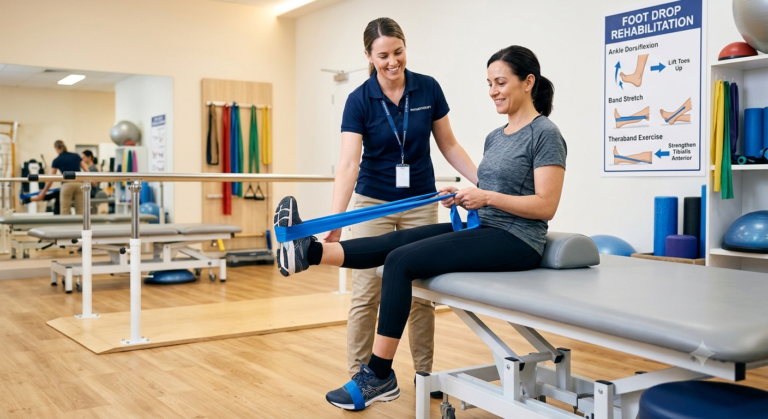
Resistance bands may be used when appropriate to strengthen ankle muscles.

Sit-to-Stand

Useful for improving lower-limb strength and functional mobility.

Supported Balance Exercises

Practice controlled weight shifting while holding a stable support.

Walking Practice

Focus on safe foot clearance and controlled steps.

Important: The appropriate exercise, resistance and repetitions depend on the underlying cause of foot drop. Patients with neurological or nerve-related conditions should receive an individualized assessment.

Foot Drop Rehabilitation: Goals

The main goals of rehabilitation may include:

Pain / discomfort management
↓
Improve muscle activation
↓
Increase ankle control
↓
Improve balance
↓
Improve foot clearance
↓
Improve walking pattern
↓
Increase functional independence

Not every patient will achieve complete recovery. Outcomes depend heavily on the underlying cause and severity.

Why Early Rehabilitation Matters

Early professional assessment can help identify the possible cause of foot drop and determine whether the problem is primarily related to nerve function, neurological impairment, muscle weakness, joint restriction, or another condition.

Timely rehabilitation may help:

  • Maintain joint mobility

  • Reduce secondary stiffness

  • Improve functional strength

  • Develop safer walking strategies

  • Reduce fall risk

  • Improve confidence during daily activities

When Should You Seek Medical Assessment?

Sudden-onset foot drop, especially when accompanied by new weakness, numbness, severe back pain, difficulty speaking, facial weakness, or other neurological symptoms, requires urgent medical assessment.

Persistent or unexplained foot drop should also be evaluated to determine its underlying cause.

Foot Drop Rehabilitation in Gurgaon

If you are looking for Foot Drop Rehabilitation in Gurgaon, physiotherapy can be an important part of a comprehensive rehabilitation program.

At Indu Physiotherapy Clinic, rehabilitation can be tailored according to the patient’s condition, including neurological and musculoskeletal causes of walking difficulty.

Treatment may focus on:

  • Foot and ankle strengthening

  • Neuromuscular rehabilitation

  • Balance training

  • Gait training

  • Functional exercises

  • Mobility improvement

  • Home exercise guidance

  • Fall-prevention strategies

Patients from areas such as Sector 38, Sector 39, Sector 40, Sector 45, Sector 46, Sector 47, Sector 48, Sector 49, Sector 50 and nearby Gurgaon/Gurugram areas can seek professional physiotherapy assessment according to their rehabilitation needs.

Frequently Asked Questions

What is foot drop?

Foot drop is difficulty lifting the front part of the foot during walking, often resulting from weakness or impaired nerve control of the muscles responsible for ankle dorsiflexion.

Can physiotherapy help foot drop?

Physiotherapy can help improve strength, mobility, balance, gait and functional movement in many people with foot drop. The potential for recovery depends on the underlying cause.

Can foot drop be completely cured?

Recovery varies. Some people improve substantially, while others may have persistent weakness. The prognosis depends on the cause, severity, nerve or neurological involvement and response to treatment.

What exercises are good for foot drop?

Depending on the cause, exercises may include ankle dorsiflexion, range-of-motion exercises, resistance training, balance exercises and gait training. A physiotherapist should select exercises according to the patient’s condition.

Can foot drop occur after a stroke?

Yes. Foot drop can occur after stroke because neurological damage may affect muscle activation and motor control of the lower limb.

Is an AFO useful for foot drop?

An ankle-foot orthosis may help some patients improve foot positioning and foot clearance during walking. Its suitability should be assessed individually.

Can foot drop be caused by a slipped disc?

Yes. Compression or irritation of nerves associated with the lower spine can sometimes contribute to weakness that results in foot drop.

Is foot drop a serious condition?

Foot drop can increase the risk of tripping and falls and may indicate an underlying nerve or neurological problem. New or unexplained foot drop should be medically assessed.

Conclusion

Foot Drop Rehabilitation focuses on improving ankle control, muscle activation, balance, walking ability and functional independence. Because foot drop can have many different causes, identifying the underlying problem is an important first step.

A structured rehabilitation program combining therapeutic exercise, gait training, balance rehabilitation, functional training and appropriate assistive strategies can help many patients work toward safer and more efficient mobility.

For persistent, sudden or unexplained foot drop, professional medical and physiotherapy assessment is recommended.

Monday8:30am–9:30pm
Tuesday8:30am–9:30pm
Wednesday8:30am–9:30pm
Thursday8:30am–9:30pm
Friday8:30am–9:30pm
Saturday8:30am–9:30pm
Sunday9:30am–9:30pm
+91-9289 059 265

Most oral emergencies relate to pain, bleeding, or thoracic pain and should be attended by a Physiotherapist.

Make an appointment

We will send you a confirmation within 24 hours. Emergency? Call +91-9289 059 265

Most oral emergencies relate to pain, bleeding, or thoracic pain and should be attended by a Physiotherapist.

    Working Hours

    Monday 8:30am–9:30pm
    Tuesday8:30am–9:30pm
    Wednesday8:30am–9:30pm
    Thursday8:30am–9:30pm
    Friday8:30am–9:30pm
    Saturday8:30am–9:30pm
    Sunday8:30am–9:30pm
    Meet the professional therapist team

    Get started with Indu Physiotherapy Clinic!