Primary SEO Keyword: Post-TKR & THR Rehab Physiotherapy in Gurgaon
Secondary Keywords: Knee replacement physiotherapy Gurgaon, Hip replacement rehabilitation Gurgaon, Post TKR exercises, THR physiotherapy treatment, Home physiotherapy after knee replacement.
Meta Title (60 Characters) Post-TKR & THR Rehab Physiotherapy in Gurgaon | Indu Physiotherapy
Meta Description (160 Characters) Expert Post-TKR & THR Rehab Physiotherapy in Gurgaon. Personalized rehabilitation after knee and hip replacement to reduce pain and improve mobility.
Post-TKR (Total Knee Replacement) and THR (Total Hip Replacement) rehabilitation is one of the most important phases after joint replacement surgery. A structured physiotherapy program helps reduce pain, improve walking ability, increase joint movement, strengthen muscles, and restore independence.
At Indu Physiotherapy Clinic, Gurgaon, we provide personalized Post-TKR & THR Rehabilitation Physiotherapy using evidence-based techniques for faster and safer recovery at the clinic and at home.
Benefits of Rehabilitation
Reduce pain and swelling.
Improve knee and hip mobility.
Restore muscle strength.
Improve balance and walking.
Return to daily activities safely.
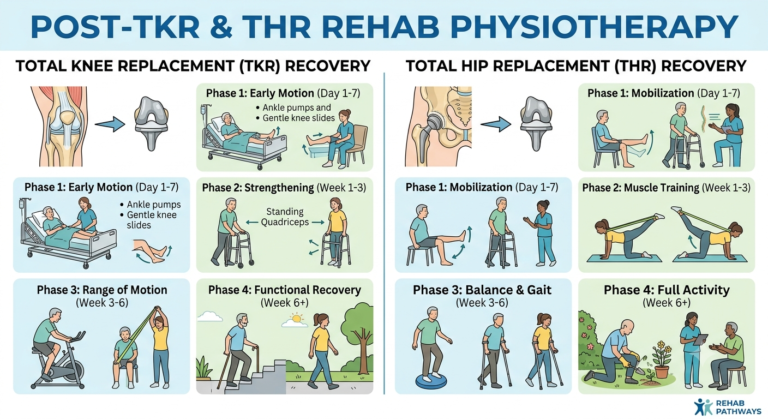
TKR rehabilitation begins immediately after surgery to regain knee bending, straightening, walking, and strength.
THR rehabilitation focuses on restoring hip movement, gait, balance, and functional independence while protecting the new hip joint.
Joint Replacement Surgery
Total Knee Replacement (TKR) / Total Hip Replacement (THR)
Pain & Swelling Management
Ice Therapy • Elevation • Gentle Mobility
Mobility & Walking Training
Range of Motion • Walker Training • Balance
Strengthening Phase
Quadriceps • Glutes • Hip & Knee Muscles
Return to Daily Activities
Stairs • Sitting • Walking • Functional Independence
| Without Physiotherapy | With Physiotherapy |
|---|---|
| Joint stiffness. | Improved flexibility and movement. |
| Weak muscles. | Better muscle strength. |
| Difficulty walking. | Normal walking pattern. |
| Poor balance. | Improved balance and coordination. |
| Slow recovery. | Faster functional recovery. |
Reduce pain and swelling.
Increase knee and hip range of motion.
Restore muscle strength.
Improve walking pattern.
Improve balance and coordination.
Prevent stiffness and blood clots.
Return to work and daily activities.
Ice Therapy.
Compression and Elevation.
Ankle Pump Exercises.
Gentle Range of Motion.
Breathing Exercises.
Bed Mobility Training.
Benefits
Reduce swelling.
Improve circulation.
Prevent stiffness.
Reduce post-operative pain.
Walker Training.
Weight Bearing Exercises.
Sit-to-Stand Practice.
Knee Bending Exercises.
Hip Mobility Exercises.
| Exercise | Purpose |
|---|---|
| Quadriceps Sets | Strengthens thigh muscles. |
| Straight Leg Raise | Improves knee stability. |
| Heel Slides | Improves knee bending. |
| Glute Bridges | Strengthens hip muscles. |
| Hip Abduction | Improves hip stability. |
Stair Climbing.
Balance Exercises.
Walking Without Walker.
Step-Up Exercises.
Functional Sit-to-Stand.
Endurance Walking.
Improves knee flexion.
Strengthens the quadriceps muscle.
Improves thigh muscle strength.
Helps achieve full knee extension.
Improves blood circulation.
Strengthens hip muscles.
Activates gluteal muscles.
Improves functional strength.
| Muscle Group | Importance |
|---|---|
| Quadriceps | Knee stability and walking. |
| Hamstrings | Knee bending and balance. |
| Gluteus Maximus | Hip strength and standing. |
| Gluteus Medius | Hip balance and walking. |
| Calf Muscles | Circulation and gait. |
| Core Muscles | Posture and stability. |
| Recovery Stage | Walking Support |
|---|---|
| Week 1 | Walker. |
| Week 2–4 | Walker or Crutches. |
| Week 4–6 | Walking Stick. |
| Week 6–12 | Independent Walking. |
Illustrative recovery timeline with regular physiotherapy after knee or hip replacement.
0%25%50%75%100%Week 1Week 2Week 4Week 6Week 8Week 12
| Do’s ✅ | Don’ts ❌ |
|---|---|
| Perform daily physiotherapy exercises. | Skip rehabilitation sessions. |
| Walk as advised by your physiotherapist. | Sit for long periods without movement. |
| Use assistive devices correctly. | Twist the operated leg suddenly. |
| Maintain proper posture while sitting. | Cross your legs after hip replacement. |
| Follow your home exercise program. | Lift heavy weights during recovery. |
Indu Physiotherapy Clinic offers professional home rehabilitation services in Gurgaon for patients who need recovery support in the comfort of their homes.
Pain management.
Walking training.
Balance exercises.
Stair climbing practice.
Personalized strengthening program.
Progress monitoring.
Personalized TKR & THR rehabilitation plans.
Experienced Orthopedic Physiotherapists.
Manual Therapy and Joint Mobilization.
Gait and Balance Training.
Home Physiotherapy Services in Gurgaon.
Strengthening and Functional Recovery Programs.
Physiotherapy usually starts within 24 hours after surgery, depending on your surgeon’s advice.
Most patients need 8–12 weeks of structured rehabilitation, while complete recovery may continue for several months.
Yes. Physiotherapy helps reduce pain, swelling, stiffness, and improves joint function through guided exercises and manual therapy.
Yes. Stair training is introduced gradually once strength and balance improve.
Yes. Indu Physiotherapy Clinic provides home physiotherapy services for post-operative TKR and THR rehabilitation across Gurgaon.
Post-TKR & THR Rehab Physiotherapy in Gurgaon is essential for a successful recovery after knee or hip replacement surgery. A personalized rehabilitation program improves mobility, strengthens muscles, restores confidence in walking, and helps patients return to an active, pain-free life.
At Indu Physiotherapy Clinic, Gurgaon, we provide comprehensive post-operative rehabilitation for knee and hip replacement patients with clinic-based and home physiotherapy services.
Most oral emergencies relate to pain, bleeding, or thoracic pain and should be attended by a Physiotherapist.
We will send you a confirmation within 24 hours. Emergency? Call +91-9289 059 265
Most oral emergencies relate to pain, bleeding, or thoracic pain and should be attended by a Physiotherapist.