(+91) 9289 059 265induphysiotherapy@gmail.com

{ I.F.T } Interferential Therapy

IFT Interferential Therapy

IFT (Interferential Therapy): Principle, Mechanism, Benefits & Physiotherapy Treatment

Interferential Therapy (IFT) is a commonly used electrotherapy technique in physiotherapy for managing pain, muscle dysfunction, swelling, and reduced circulation. It uses two medium-frequency electrical currents that interact within the tissues to produce a therapeutic low-frequency effect.

IFT may be incorporated into a physiotherapy treatment plan for conditions such as back pain, neck pain, knee pain, arthritis, sports injuries, muscle spasm, soft-tissue injuries, and post-injury rehabilitation.

What Is Interferential Therapy (IFT)?

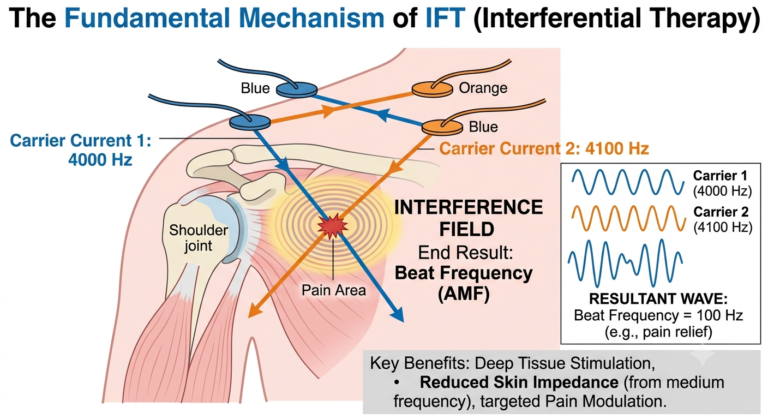
Interferential Therapy (IFT) is an electrotherapy treatment in which two medium-frequency alternating currents are applied through electrodes placed around the affected body region.

When these currents intersect, they create an interference or beat-frequency effect. This therapeutic effect can stimulate sensory nerves, motor nerves, and local tissues depending on the treatment settings.

Simple Flow Diagram

IFT Machine

↓

Two Medium-Frequency Currents

↓

Currents Cross/Intersect in the Treatment Area

↓

Interference / Beat Frequency

↓

Nerve & Tissue Stimulation

↓

Pain Modulation + Muscle Response + Circulatory Effects

↓

Improved Comfort & Functional Movement


Principle of Interferential Therapy

The basic principle of IFT is interference between two medium-frequency electrical currents.

Typically, two currents with slightly different frequencies are delivered through separate channels. Where the currents overlap, their amplitudes periodically increase and decrease.

This produces a beat frequency.

Example

If:

  • Current 1 = 4000 Hz

  • Current 2 = 4100 Hz

Then:

4100 − 4000 = 100 Hz beat frequency

The resulting beat frequency can be selected according to the therapeutic objective.

Principle in Simple Words

Two medium-frequency currents → interference → therapeutic beat frequency → physiological response

Medium-frequency currents can also be more comfortable for some patients because they encounter less skin impedance than very low-frequency currents.

How Does IFT Work?

IFT works primarily by stimulating nerves and influencing the way the nervous system processes sensory information.

The exact physiological response depends on the frequency, intensity, electrode placement, treatment duration, tissue condition, and patient’s response.

Mechanism of Action

Electrodes placed around painful area

↓

Electrical current passes through tissues

↓

Two currents interact

↓

Beat frequency is produced

↓

Peripheral nerves are stimulated

↓

Sensory input reaches the nervous system

↓

Pain perception may be reduced

↓

Muscle relaxation and/or muscle contraction may occur depending on settings

↓

Movement and function may become easier

Pathophysiology: Why Does Pain Occur?

Understanding the pathophysiology of pain helps explain why IFT may be used as part of physiotherapy.

For example, after a soft-tissue injury:

Injury / Overuse

↓

Tissue irritation

↓

Inflammatory response

↓

Chemical mediators released

↓

Nociceptor sensitisation

↓

Pain signals transmitted through peripheral nerves

↓

Spinal cord processing

↓

Brain perceives pain

Pain may also lead to:

Pain → Protective muscle guarding → Reduced movement → Stiffness → Reduced function

IFT may be used to help modulate pain and make therapeutic exercises, manual therapy, and functional rehabilitation more comfortable.

IFT and Pain Modulation

One proposed mechanism of electrical stimulation is activation of sensory nerve fibres, which can influence pain processing within the spinal cord and higher nervous system.

Simplified Pain-Modulation Diagram

Painful Tissue

↓

Nociceptive Signals

↓

Peripheral Nerve

↓

Spinal Cord

↓

Brain

With Therapeutic Electrical Stimulation

IFT Stimulation

↓

Sensory Nerve Activation

↓

Altered Sensory Input

↓

Modulation of Nociceptive Processing

↓

Reduced Pain Perception in Some Patients

IFT should therefore be considered a symptom-management tool, rather than a treatment that automatically corrects the underlying structural cause of pain.

IFT and Muscle Spasm

Pain can cause protective muscle guarding.

Common Cycle

Pain

↓

Muscle Guarding

↓

Increased Muscle Tension

↓

Restricted Movement

↓

More Discomfort

IFT may be applied with appropriate settings to produce sensory or motor stimulation, depending on the clinical goal.

When motor stimulation is used, repeated stimulation may produce muscle contractions.

Electrical Stimulation → Motor Nerve Activation → Muscle Contraction → Functional Muscle Response

The exact response depends on the treatment parameters and electrode placement.

IFT and Circulation

Electrical stimulation can influence local physiological responses. When appropriate motor stimulation produces rhythmic muscle contractions, the resulting muscle-pump activity may support venous and lymphatic fluid movement.

Simplified Flow

Electrical Stimulation

↓

Muscle Activation

↓

Rhythmic Muscle Contraction

↓

Muscle Pump Effect

↓

Improved Fluid Movement

This should not be interpreted as a guarantee that IFT will directly increase circulation in every patient.

IFT Treatment Process

A physiotherapist should first assess the patient’s condition before selecting IFT parameters.

Step 1 – Assessment

The physiotherapist evaluates:

  • Pain location

  • Pain intensity

  • Range of motion

  • Muscle condition

  • Swelling

  • Sensation

  • Functional limitations

  • Medical history

  • Contraindications

Step 2 – Skin Check

The treatment area is inspected for:

  • Open wounds

  • Skin irritation

  • Infection

  • Reduced sensation

  • Other conditions that may make electrical stimulation unsuitable

Step 3 – Electrode Placement

Electrodes are positioned around the treatment area according to the clinical objective.

Step 4 – Parameter Selection

The physiotherapist selects appropriate:

  • Carrier frequency

  • Beat frequency

  • Intensity

  • Treatment duration

  • Electrode configuration

Step 5 – Gradual Intensity

The intensity is increased gradually according to the patient’s comfort and the intended physiological response.

Step 6 – Monitoring

The patient is monitored throughout the treatment.

Step 7 – Rehabilitation

IFT is often combined with active physiotherapy such as:

IFT → Pain Relief → Exercise → Mobility Training → Strengthening → Functional Recovery

Common Physiotherapy Uses of IFT

IFT may be considered as an adjunct in the management of:

Musculoskeletal Conditions

  • Low back pain

  • Neck pain

  • Knee pain

  • Shoulder pain

  • Osteoarthritis

  • Muscle spasm

  • Soft-tissue injuries

  • Tendinopathy

  • Sports injuries

  • Joint stiffness

Rehabilitation

IFT may also be used alongside rehabilitation for selected patients experiencing pain or muscle dysfunction after injury or surgery.

The treatment should always be based on individual assessment rather than the diagnosis alone.

Benefits of IFT

Potential clinical benefits may include:

  • Pain modulation

  • Temporary reduction in pain intensity

  • Improved comfort during rehabilitation

  • Reduction of muscle guarding in selected cases

  • Support for active movement

  • Assistance with exercise tolerance

  • Possible reduction of discomfort associated with some musculoskeletal conditions

Important: IFT is generally an adjunct to physiotherapy rather than a stand-alone cure.

IFT Treatment Parameters

IFT parameters should be individualized rather than using one setting for every patient.

Parameters may include:

Parameter Purpose
Carrier frequency Influences tissue stimulation and patient comfort
Beat frequency Determines the therapeutic low-frequency effect
Intensity Controls strength of stimulation
Treatment duration Determines exposure time
Electrode placement Determines the treatment field
Mode Can influence the stimulation pattern

The physiotherapist chooses parameters according to the patient’s condition, treatment goal, tolerance, and clinical assessment.

IFT vs Conventional TENS

Although both are forms of electrical stimulation, IFT and TENS are not identical.

IFT TENS
Uses medium-frequency carrier currents Usually uses lower-frequency pulsed stimulation
Uses interference/beat-frequency principles Uses pulsed electrical stimulation
Often uses two or four electrodes depending on the device Commonly uses two or four electrodes
Frequently used in physiotherapy clinics Frequently used for pain management
Parameters are selected according to treatment goal Parameters are selected according to pain-management goal

The most appropriate modality depends on the individual patient and clinical objective.

Precautions and Contraindications

IFT is not suitable for everyone. A physiotherapist should screen the patient before treatment.

Electrical stimulation may be unsuitable or require special precautions in situations such as:

  • Implanted electronic devices

  • Certain cardiac conditions

  • Pregnancy, depending on treatment area and clinical circumstances

  • Active infection

  • Open wounds in the treatment area

  • Significant loss of sensation

  • Malignancy in the treatment area

  • Areas where electrical stimulation is medically inappropriate

Treatment should not be applied across the front of the neck, eyes, or other sensitive areas unless specifically appropriate and professionally indicated.

Always inform your physiotherapist about your medical history, implanted devices, pregnancy, medications, and changes in sensation before receiving IFT.

Is IFT Painful?

IFT is generally intended to feel comfortable.

A patient may experience:

  • Tingling

  • Pulsing

  • Vibrating sensation

  • Mild muscle contraction when motor stimulation is used

The intensity should be adjusted according to the treatment objective and patient tolerance.

Sharp pain, burning, excessive discomfort, or unusual symptoms should be reported immediately.

Does IFT Cure the Root Cause of Pain?

IFT primarily aims to modulate symptoms and support rehabilitation.

For example, if a patient has knee osteoarthritis:

Osteoarthritis

↓

Joint/Tissue Changes

↓

Pain

↓

Reduced Movement

IFT may help with the pain component, but it does not reverse the underlying osteoarthritis.

Therefore, a complete physiotherapy program may include:

Pain Management

  •  

Joint Mobility

  •  

Muscle Strengthening

  •  

Flexibility

  •  

Balance / Proprioception

  •  

Functional Training

  •  

Patient Education

This combined approach is generally more important for long-term functional improvement.

Diagrammatic Summary of IFT

IFT Treatment Mechanism

IFT Machine

⬇

Medium-Frequency Currents

⬇

Current 1 + Current 2

⬇

Interference

⬇

Beat Frequency

⬇

Peripheral Nerve Stimulation

⬇

Pain Modulation / Muscle Response

⬇

Improved Movement & Exercise Tolerance

⬇

Functional Rehabilitation

Patient-Friendly Explanation

Think of IFT as a controlled electrical stimulation technique used by a physiotherapist to influence pain and tissue responses.

Two electrical currents are delivered through electrodes. Where they interact, they create a therapeutic beat frequency. Depending on the selected settings, this stimulation can influence sensory nerves or motor nerves.

IFT may help reduce discomfort sufficiently for the patient to participate more comfortably in exercise, stretching, mobility training, strengthening, and functional rehabilitation.

Why Combine IFT With Exercise?

IFT may provide short-term symptom relief, but rehabilitation usually requires more than passive treatment.

A comprehensive physiotherapy plan may follow this sequence:

Assessment

↓

Pain Management

↓

IFT / Other Appropriate Modalities

↓

Joint & Soft-Tissue Mobility

↓

Stretching

↓

Strengthening

↓

Balance & Coordination

↓

Functional Training

↓

Home Exercise Program

This approach addresses both symptoms and physical impairments.

Frequently Asked Questions About IFT

What is IFT in physiotherapy?

IFT stands for Interferential Therapy. It is an electrotherapy technique that uses interacting medium-frequency electrical currents to produce a therapeutic beat frequency.

What is IFT used for?

IFT may be used as an adjunct for pain management and rehabilitation in selected musculoskeletal and other conditions.

How does IFT reduce pain?

IFT can stimulate sensory nerves and influence pain processing. This may reduce pain perception in some patients and improve tolerance to active rehabilitation.

Is IFT safe?

When appropriately prescribed and administered after proper screening, IFT is generally considered safe. However, it is not appropriate for every patient.

How long does IFT treatment take?

Treatment duration varies according to the patient’s condition, treatment objective, and physiotherapist’s assessment.

Can IFT be used with exercise?

Yes. IFT can be used as an adjunct to an active physiotherapy program that includes mobility exercises, strengthening, stretching, balance training, and functional rehabilitation.

Is IFT better than exercise?

No. IFT and exercise serve different purposes. Exercise is an important part of restoring strength, mobility, function, and physical capacity, while IFT may be used for symptom management in selected patients

Conclusion

Interferential Therapy (IFT) is a useful electrotherapy modality that uses the interaction of medium-frequency electrical currents to create a therapeutic beat frequency. Its effects may include pain modulation, sensory stimulation, muscle activation, and support for rehabilitation depending on the selected parameters.

For the best results, IFT should be used as part of an individualized physiotherapy program rather than as a replacement for exercise and functional rehabilitation.

If you are experiencing back pain, neck pain, knee pain, shoulder pain, muscle spasm, sports injury, or joint discomfort, a qualified physiotherapist can assess your condition and determine whether IFT is appropriate for you.

Monday8:30am–9:30pm
Tuesday8:30am–9:30pm
Wednesday8:30am–9:30pm
Thursday8:30am–9:30pm
Friday8:30am–9:30pm
Saturday8:30am–9:30pm
Sunday9:30am–9:30pm
+91-9289 059 265

Most oral emergencies relate to pain, bleeding, or thoracic pain and should be attended by a Physiotherapist.

Make an appointment

We will send you a confirmation within 24 hours. Emergency? Call +91-9289 059 265

Most oral emergencies relate to pain, bleeding, or thoracic pain and should be attended by a Physiotherapist.

    Working Hours

    Monday 8:30am–9:30pm
    Tuesday8:30am–9:30pm
    Wednesday8:30am–9:30pm
    Thursday8:30am–9:30pm
    Friday8:30am–9:30pm
    Saturday8:30am–9:30pm
    Sunday8:30am–9:30pm
    Meet the professional therapist team

    Get started with Indu Physiotherapy Clinic!