(+91) 9289 059 265induphysiotherapy@gmail.com

Hip Replacement Physiotherapy Treatment

Hip Replacement Physiotherapy

Hip Replacement Physiotherapy Treatment in Gurgaon

hip replacement physiotherapy
 

Hip replacement surgery can significantly reduce hip pain and improve mobility, but proper rehabilitation is an important part of recovery. Hip replacement physiotherapy treatment helps patients gradually restore strength, flexibility, balance, walking ability, and confidence after surgery.

At Indu Physiotherapy Clinic, physiotherapy rehabilitation is planned according to the patient’s age, surgical procedure, medical condition, muscle strength, mobility level, and recovery goals. Treatment focuses on safe movement, progressive strengthening, functional training, and a gradual return to daily activities.

What Is Hip Replacement Surgery?

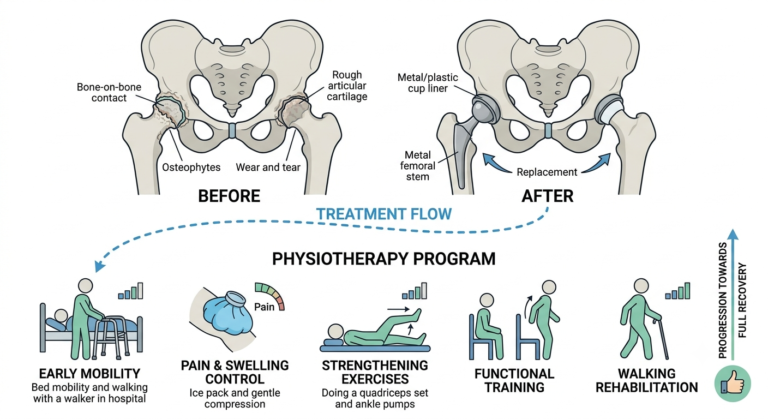
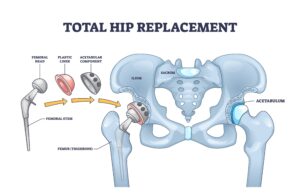
Hip replacement, also called total hip arthroplasty, is a surgical procedure in which damaged portions of the hip joint are replaced with artificial components.

The hip is a ball-and-socket joint. The rounded head of the femur fits into the socket of the pelvis. Conditions such as severe osteoarthritis, rheumatoid arthritis, hip fracture, avascular necrosis, or advanced joint damage may cause persistent pain and difficulty walking.

After surgery, the joint has been replaced, but the surrounding muscles and soft tissues may still be weak. Physiotherapy helps the body adapt to the new joint and regain functional movement.

Why Is Physiotherapy Important After Hip Replacement?

Following hip replacement surgery, patients may experience:

  • Hip and leg muscle weakness

  • Difficulty walking

  • Reduced balance

  • Stiffness around the hip

  • Difficulty climbing stairs

  • Reduced endurance

  • Fear of putting weight on the operated leg

  • Difficulty getting in and out of a chair or bed

  • Reduced confidence during daily activities

A structured hip replacement rehabilitation program can help address these problems progressively.

Main Goals of Physiotherapy

Pain & swelling control → Mobility → Muscle activation → Strength → Balance → Walking → Functional independence

Hip Replacement Physiotherapy Rehabilitation: Step-by-Step

Stage 1: Early Post-Surgery Rehabilitation

The initial phase focuses on safe movement and basic functional independence.

Physiotherapy may include:

  • Breathing and circulation exercises

  • Ankle pumps

  • Gentle muscle activation

  • Bed mobility training

  • Safe sitting and standing

  • Transfer training

  • Assisted walking

  • Walker or walking-aid training

  • Education about precautions

The physiotherapist gradually encourages movement while respecting the surgeon’s weight-bearing and movement instructions.

Stage 2: Improving Hip and Leg Strength

After the initial healing period, rehabilitation progresses toward strengthening the muscles supporting the hip.

Common exercises may include:

  • Quadriceps activation

  • Gluteal strengthening

  • Heel slides

  • Straight-leg exercises when appropriate

  • Hip abductor strengthening

  • Supported mini-squats

  • Sit-to-stand exercises

  • Controlled step exercises

The intensity is gradually increased according to the patient’s recovery.

Stage 3: Gait and Walking Rehabilitation

Walking mechanics are an important part of hip replacement physiotherapy.

The physiotherapist assesses:

Foot placement → Weight transfer → Hip control → Knee alignment → Balance → Walking speed

Treatment may include:

  • Walking with a walker

  • Progression to a stick when appropriate

  • Weight-shifting exercises

  • Step training

  • Gait correction

  • Balance exercises

  • Walking endurance training

The aim is to develop a safer and more natural walking pattern.

Diagram: Hip Replacement Physiotherapy Treatment Flow

Hip Replacement Surgery
↓
Pain / Swelling / Muscle Weakness
↓
Physiotherapy Assessment
↓
Mobility & Circulation Exercises
↓
Muscle Activation
↓
Progressive Strengthening
↓
Balance & Gait Training
↓
Stair & Functional Training
↓
Independent Daily Activities

Hip Replacement Exercises

Depending on the stage of recovery and medical advice, physiotherapy exercises may include:

1. Ankle Pumps

Ankle movements encourage lower-limb circulation and can be introduced early after surgery.

2. Quadriceps Setting

Gentle thigh muscle activation helps reduce weakness caused by reduced activity.

3. Gluteal Contractions

Activating the buttock muscles supports hip stability and functional movement.

4. Sit-to-Stand Training

This exercise helps improve the ability to get up from a chair and strengthens the lower limbs.

5. Hip Abductor Strengthening

Strengthening the muscles around the side of the hip can improve pelvic stability during walking.

6. Balance Training

Progressive balance exercises help improve confidence and reduce the risk of losing balance.

Important: Exercises should be selected according to the surgical approach, healing stage, weight-bearing status, and instructions provided by the surgeon and physiotherapist.

Physiotherapy After Hip Replacement: Functional Rehabilitation

Recovery is not only about reducing pain. The ultimate goal is to help the patient return to meaningful daily activities.

Physiotherapy may include training for:

  • Walking independently

  • Getting out of bed

  • Sitting and standing

  • Using stairs

  • Getting into and out of a car

  • Household activities

  • Workplace activities

  • Community walking

  • Improving endurance

  • Safe recreational activities

Functional rehabilitation is progressed gradually rather than forcing the joint to recover too quickly.

Hip Replacement Precautions

Hip precautions can vary depending on the surgical approach and the surgeon’s instructions. Patients should follow their specific postoperative guidance.

Depending on the surgical procedure, precautions may include avoiding certain combinations of hip movements, excessive twisting, sudden loading, or unsafe positions during the early healing period.

A physiotherapist can teach the patient how to:

  • Sit safely

  • Stand safely

  • Use walking aids

  • Perform bed transfers

  • Navigate stairs

  • Move safely around the home

  • Progress exercises appropriately

Benefits of Hip Replacement Physiotherapy

A professionally supervised rehabilitation program may help with:

Pain Management

Appropriate movement and rehabilitation strategies can help manage postoperative discomfort.

Improved Muscle Strength

Progressive exercises help rebuild strength in the hip and lower-limb muscles.

Better Walking

Gait training helps improve walking control, stability, and confidence.

Improved Balance

Balance exercises can help patients feel safer during standing and walking.

Better Functional Mobility

Patients can gradually work toward greater independence with everyday activities.

Increased Confidence

Structured rehabilitation can reduce fear of movement and encourage safe participation in daily activities.

Hip Replacement Rehabilitation Timeline

Recovery is different for every patient. Age, general fitness, surgical technique, pre-surgery muscle strength, medical conditions, and adherence to rehabilitation can all influence recovery.

Early Phase

Focus: Pain control, circulation, mobility, transfers and assisted walking.

Intermediate Phase

Focus: Strengthening, balance, gait correction and increasing walking tolerance.

Advanced Phase

Focus: Functional exercises, stairs, endurance and greater independence.

Long-Term Phase

Focus: Maintaining strength, mobility, healthy body weight, balance and appropriate physical activity.

There is no single recovery timeline that is suitable for everyone. Rehabilitation should progress according to individual clinical assessment and medical advice.

Who May Need Physiotherapy After Hip Replacement?

Hip replacement rehabilitation may be recommended for people recovering from surgery due to:

  • Hip osteoarthritis

  • Severe hip joint degeneration

  • Femoral head problems

  • Avascular necrosis

  • Hip fracture-related joint damage

  • Rheumatoid arthritis

  • Other conditions causing advanced hip joint damage

Physiotherapy may also be useful for patients who continue to experience weakness, walking difficulties, reduced balance, or functional limitations after surgery.

Why Choose Indu Physiotherapy Clinic for Hip Replacement Rehabilitation in Gurgaon?

At Indu Physiotherapy Clinic, rehabilitation is focused on individualized recovery rather than a one-size-fits-all exercise program.

Our physiotherapy approach may include:

Assessment → Personalized exercise program → Strengthening → Gait training → Balance training → Functional rehabilitation → Home exercise guidance

The program is modified as the patient’s strength, mobility and functional ability improve.

If you are searching for hip replacement physiotherapy in Gurgaon, professional rehabilitation can help you work toward safer movement, improved strength, better walking ability, and greater independence.

Frequently Asked Questions

1. When should physiotherapy start after hip replacement?

Physiotherapy often begins early after surgery, sometimes during the hospital stay, depending on the patient’s medical condition and surgeon’s instructions.

2. How long does hip replacement physiotherapy take?

The duration varies from person to person. Some patients progress quickly, while others require a longer rehabilitation period because of age, weakness, medical conditions or pre-surgery limitations.

3. Can physiotherapy improve walking after hip replacement?

Yes. Gait training, strengthening, balance exercises and functional practice can help improve walking ability and confidence.

4. Can I exercise after hip replacement?

Exercise is generally an important part of recovery, but the type and intensity should be appropriate for the healing stage and surgical precautions.

5. Is physiotherapy necessary after hip replacement?

A structured rehabilitation program can be highly beneficial for restoring strength, mobility, balance and functional independence after surgery.

6. Can hip replacement physiotherapy be done at home?

Depending on the patient’s condition and rehabilitation needs, physiotherapy may be provided at home. A physiotherapist can assess the home environment and provide suitable exercises and mobility training.

7. When can I climb stairs after hip replacement?

Stair training is commonly introduced progressively when the patient is medically stable and able to perform the movement safely. The timing depends on individual recovery and medical instructions.

Conclusion

Hip replacement surgery can restore a damaged hip joint, but rehabilitation plays an important role in helping patients regain functional movement. With appropriate physiotherapy, patients can progressively work on muscle strength, balance, walking ability, flexibility, endurance and everyday activities.

If you are looking for Hip Replacement Physiotherapy Treatment in Gurgaon, an individualized rehabilitation program can help you progress safely toward greater mobility and independence.

Indu Physiotherapy Clinic – Physiotherapy & Rehabilitation Care in Gurgaon

 
Monday8:30am–9:30pm
Tuesday8:30am–9:30pm
Wednesday8:30am–9:30pm
Thursday8:30am–9:30pm
Friday8:30am–9:30pm
Saturday8:30am–9:30pm
Sunday9:30am–9:30pm
+91-9289 059 265

Most oral emergencies relate to pain, bleeding, or thoracic pain and should be attended by a Physiotherapist.

Make an appointment

We will send you a confirmation within 24 hours. Emergency? Call +91-9289 059 265

Most oral emergencies relate to pain, bleeding, or thoracic pain and should be attended by a Physiotherapist.

    Working Hours

    Monday 8:30am–9:30pm
    Tuesday8:30am–9:30pm
    Wednesday8:30am–9:30pm
    Thursday8:30am–9:30pm
    Friday8:30am–9:30pm
    Saturday8:30am–9:30pm
    Sunday8:30am–9:30pm
    Meet the professional therapist team

    Get started with Indu Physiotherapy Clinic!