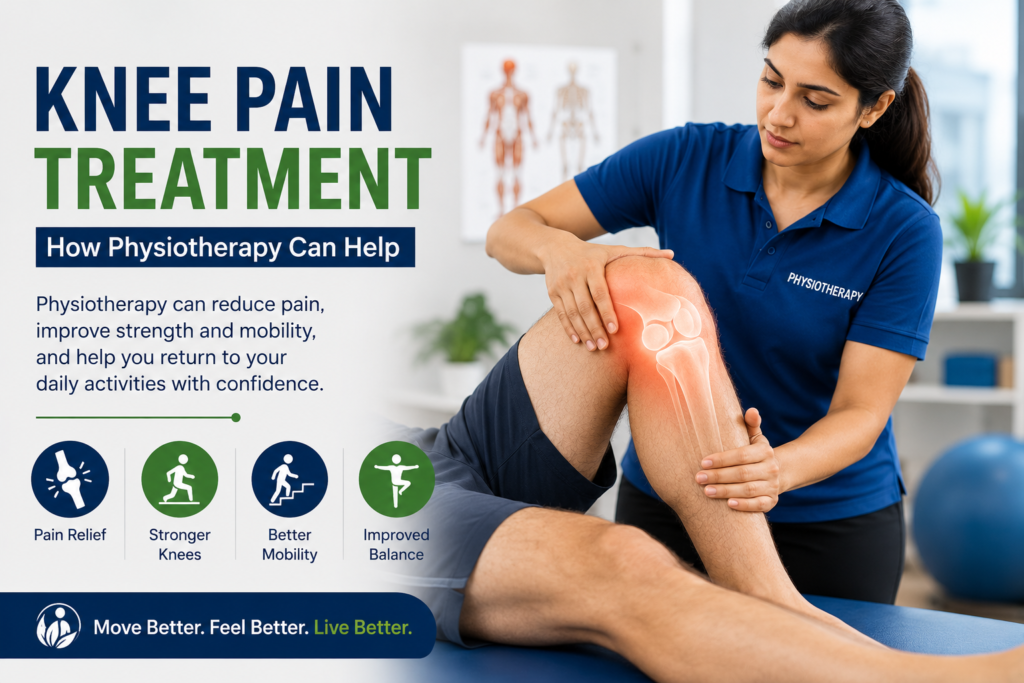
Knee pain is a common problem that can affect people of all ages. It may develop because of an injury, overuse, arthritis, muscle weakness, poor movement patterns, or age-related changes. Knee pain can make everyday activities such as walking, climbing stairs, standing, exercising, or getting up from a chair difficult.
Knee pain treatment depends on the underlying cause and severity of the problem. Physiotherapy can play an important role in managing knee pain by improving strength, flexibility, joint mobility, balance, and movement control.
A physiotherapist can assess your knee and develop a personalized treatment program designed around your symptoms, physical condition, and daily activities.
What Is Knee Pain?
Knee pain refers to discomfort around or inside the knee joint. It may occur suddenly after an injury or gradually develop over time.
Knee pain may be felt:
- In the front of the knee
- Behind the knee
- On the inner side
- On the outer side
- Around the kneecap
- Throughout the knee joint
The pain may be mild and occasional or persistent and severe enough to interfere with daily activities.
Common Causes of Knee Pain
There are many possible causes of knee pain. Some common causes include:
1. Knee Osteoarthritis
Knee osteoarthritis is a common condition involving changes in the joint that can cause pain, stiffness, and difficulty with movement.
2. Sports Injuries
Running, jumping, sudden changes in direction, and contact sports can place stress on the knee. Injuries may involve muscles, tendons, ligaments, or other structures around the knee.
3. Ligament Injuries
Ligaments help stabilize the knee. Injuries involving structures such as the ACL, MCL, or other knee ligaments can cause pain, swelling, and instability.
4. Meniscus Injuries
The menisci are structures inside the knee that help distribute load and support joint function. Injury or degeneration can cause pain, swelling, and difficulty with certain movements.
5. Patellofemoral Pain
Pain around or behind the kneecap can sometimes be associated with patellofemoral pain. Activities such as squatting, running, or climbing stairs may aggravate symptoms.
6. Muscle Weakness
Weakness in the quadriceps, hamstrings, gluteal muscles, or calf muscles can affect how the knee moves and handles load.
7. Overuse
Repeated activities without adequate recovery may contribute to knee discomfort, particularly when activity levels increase suddenly.
8. Tendon Problems
Irritation or overloading of tendons around the knee can cause localized pain, particularly during activities involving jumping, running, or repeated bending.
Symptoms Associated With Knee Pain
Knee pain can present differently depending on its underlying cause.
Common symptoms include:
- Knee pain while walking
- Knee stiffness
- Swelling around the knee
- Difficulty climbing stairs
- Pain while squatting
- Pain after prolonged sitting
- Difficulty standing up from a chair
- Reduced knee movement
- Muscle weakness
- Knee instability
- Difficulty running or exercising
- Tenderness around the knee
If knee pain is severe, occurs after significant trauma, or is accompanied by marked swelling, inability to bear weight, deformity, fever, or other concerning symptoms, medical assessment should be sought promptly.
How Is Knee Pain Diagnosed?
A physiotherapy assessment typically begins with a detailed discussion about your symptoms, activities, previous injuries, and medical history.
The physiotherapist may assess:
- Knee movement
- Muscle strength
- Flexibility
- Joint mobility
- Balance
- Walking pattern
- Squatting and functional movements
- Muscle control
- Pain during specific activities
If there is concern about a serious injury or another medical condition, referral to an appropriate healthcare professional may be recommended.
What Is Knee Pain Treatment?
Knee pain treatment aims to address the underlying cause, reduce functional limitations, and help you return to comfortable movement.
Depending on the condition, treatment may include:
- Therapeutic exercises
- Strengthening exercises
- Stretching
- Mobility exercises
- Manual therapy
- Balance training
- Gait and movement retraining
- Activity modification
- Education about managing physical load
- Home exercise programs
The treatment plan should be tailored to the individual’s condition rather than using the same exercises for every type of knee pain.
How Physiotherapy Can Help With Knee Pain
Physiotherapy can be an important part of conservative knee pain management.
1. Physiotherapy Assessment
The physiotherapist first identifies factors that may be contributing to your knee symptoms.
The assessment may examine the knee as well as related areas such as the hip, ankle, and foot because movement at these regions can influence overall lower-limb mechanics.
2. Knee Strengthening Exercises
Strengthening is often an important part of rehabilitation.
Depending on your condition, a physiotherapist may prescribe exercises targeting:
- Quadriceps
- Hamstrings
- Gluteal muscles
- Calf muscles
- Hip muscles
- Core muscles
Stronger muscles can help improve movement control and the ability to perform daily and sporting activities.
3. Flexibility and Mobility Exercises
Restricted movement in the knee, hip, ankle, or surrounding muscles may affect function.
Appropriate stretching and mobility exercises can help improve movement when limited flexibility or mobility is contributing to the problem.
4. Manual Therapy
When appropriate, a physiotherapist may use hands-on techniques to address joint or soft-tissue restrictions.
Manual therapy may be combined with active exercises to support functional improvement.
5. Balance and Stability Training
Some knee conditions can affect balance and lower-limb control.
A physiotherapist may introduce progressive balance and stability exercises to help improve confidence and movement control.
6. Gait and Movement Training
The way you walk, squat, climb stairs, or perform other activities can sometimes contribute to symptoms.
A physiotherapist can teach appropriate movement strategies and gradually help you return to normal activities.
7. Activity Modification
Complete rest is not always necessary for knee pain. In many cases, modifying the amount, intensity, or frequency of an activity can help manage symptoms while maintaining appropriate physical activity.
Your physiotherapist can help you determine how to safely progress your activity.
Knee Pain Exercises
The most appropriate exercises depend on the cause of knee pain, your current strength, mobility, and symptoms.
Common exercise categories used during knee rehabilitation include:
Quadriceps Strengthening
Exercises targeting the quadriceps can help improve the strength and control needed for activities such as walking, standing, and climbing stairs.
Straight Leg Raises
Straight leg raises may be used in some rehabilitation programs to strengthen the muscles around the thigh while controlling knee movement.
Sit-to-Stand Exercises
Sit-to-stand movements can help improve functional leg strength and are useful for everyday activities.
Step-Up Exercises
Progressive step-up exercises can help develop strength and control needed for climbing stairs and other functional movements.
Glute Strengthening
Exercises targeting the hip and gluteal muscles may help improve lower-limb movement control.
Calf Strengthening
Calf exercises can support strength and control during walking and other weight-bearing activities.
Important: Not every exercise is appropriate for every knee condition. Exercises that significantly increase pain should be reviewed with a qualified healthcare professional.
Knee Pain While Walking
Knee pain while walking can have several causes, including arthritis, injury, muscle weakness, tendon problems, or other joint conditions.
Physiotherapy may help by assessing your walking pattern and addressing strength, mobility, balance, and movement-control problems.
A gradual return to walking and other activities may be recommended depending on the underlying condition.
Knee Pain While Climbing Stairs
Climbing stairs places greater demands on the muscles around the knee and hip.
Pain while climbing stairs may occur with conditions such as patellofemoral pain, osteoarthritis, muscle weakness, or other knee problems.
Physiotherapy can focus on strengthening and movement retraining to help improve stair-climbing ability.
Knee Pain After Exercise
Knee discomfort after exercise can sometimes occur when training load increases too quickly or when the body has not had enough time to adapt.
Useful strategies may include:
- Gradually increasing exercise intensity
- Allowing appropriate recovery
- Improving muscle strength
- Reviewing exercise technique
- Avoiding sudden increases in training volume
- Working with a physiotherapist when symptoms persist
Persistent pain should not simply be ignored or repeatedly pushed through.
Knee Pain and Osteoarthritis
Knee osteoarthritis can cause pain, stiffness, reduced mobility, and difficulty with everyday activities.
Physiotherapy may help people with knee osteoarthritis through:
- Strengthening exercises
- Aerobic activity
- Mobility exercises
- Functional training
- Weight-bearing exercise appropriate to the individual
- Education about activity management
- Home exercise programs
Exercise is often an important component of long-term knee osteoarthritis management.
Knee Pain After an Injury
Following a knee injury, rehabilitation depends on the type and severity of the injury.
A physiotherapist may help with:
- Restoring appropriate movement
- Managing swelling and symptoms
- Improving muscle strength
- Restoring balance and stability
- Rebuilding confidence
- Gradually returning to normal activities
- Progressing toward sport-specific activities when appropriate
More serious injuries may require medical or orthopedic evaluation.
How Long Does Knee Pain Treatment Take?
The recovery time varies from person to person.
It depends on factors such as:
- The underlying cause
- Severity of the condition
- Duration of symptoms
- Age and general fitness
- Muscle strength
- Activity level
- Previous injuries
- Consistency with rehabilitation
- Treatment response
Some mild problems may improve relatively quickly, while chronic conditions or significant injuries may require a longer rehabilitation program.
Tips to Prevent Knee Pain
Although not all knee problems can be prevented, several habits may help support healthy knee function:
- Maintain regular physical activity.
- Strengthen the muscles around the hips and knees.
- Increase exercise intensity gradually.
- Avoid sudden increases in training volume.
- Maintain appropriate flexibility and mobility.
- Use proper technique during exercise.
- Take adequate recovery between demanding activities.
- Maintain a healthy body weight when appropriate.
- Address persistent pain early.
- Follow a personalized rehabilitation program after an injury.
When Should You See a Physiotherapist for Knee Pain?
Consider consulting a physiotherapist if knee pain:
- Continues for several days or weeks
- Interferes with walking
- Makes stairs difficult
- Limits exercise or sports
- Causes recurrent stiffness
- Is associated with muscle weakness
- Keeps returning after physical activity
- Develops after an injury
- Affects your daily activities
A professional assessment can help identify possible contributing factors and determine whether physiotherapy is appropriate.
Knee Pain Treatment in Gurgaon
If you are looking for knee pain treatment in Gurgaon, physiotherapy can provide a structured approach to managing many common musculoskeletal knee problems.
At Indu Physiotherapy Clinic, treatment can be tailored according to your symptoms, physical assessment, activity level, and rehabilitation goals. Depending on your condition, a physiotherapy program may include therapeutic exercises, strengthening, mobility training, manual techniques, balance exercises, movement retraining, and guidance for managing daily activities.
For severe or unexplained knee pain, an appropriate medical evaluation may be recommended before or alongside physiotherapy.
Frequently Asked Questions About Knee Pain Treatment
What is the best treatment for knee pain?
The best treatment depends on the cause of the knee pain. Physiotherapy, exercise, activity modification, and medical management may be used depending on the specific condition.
Can physiotherapy reduce knee pain?
Physiotherapy can help many people with knee pain by improving muscle strength, mobility, movement control, and functional capacity. The effectiveness depends on the underlying condition.
Which exercises are good for knee pain?
Exercise selection depends on the cause and severity of the knee problem. Common rehabilitation exercises may target the quadriceps, hamstrings, gluteal muscles, calves, and core.
Can knee pain be treated without surgery?
Many knee conditions can be managed conservatively without surgery, depending on the diagnosis and severity. Physiotherapy and exercise are commonly used as part of non-surgical management.
Is walking good for knee pain?
Walking may be appropriate for many people, but the amount and intensity should be adjusted according to symptoms and the underlying condition. A physiotherapist can help determine an appropriate activity level.
Can physiotherapy help knee osteoarthritis?
Yes. Physiotherapy can help people with knee osteoarthritis improve strength, mobility, physical function, and confidence with movement. Exercise is an important component of conservative management.
Should I exercise when my knee hurts?
It depends on the cause and severity of the pain. Some forms of exercise may be beneficial, while certain activities may need to be modified temporarily. Professional assessment is recommended when pain is persistent or worsening.
Conclusion
Knee pain treatment should focus on the underlying cause rather than simply treating the location of the pain. Physiotherapy can help many people improve knee strength, flexibility, mobility, balance, and movement control through an individualized rehabilitation program.
Whether knee pain is related to overuse, muscle weakness, osteoarthritis, sports activity, or an injury, appropriate assessment and progressive rehabilitation can support a safe return to everyday activities and exercise.
If your knee pain is persistent, worsening, or interfering with your daily life, consult a qualified healthcare professional for an appropriate assessment and treatment plan.