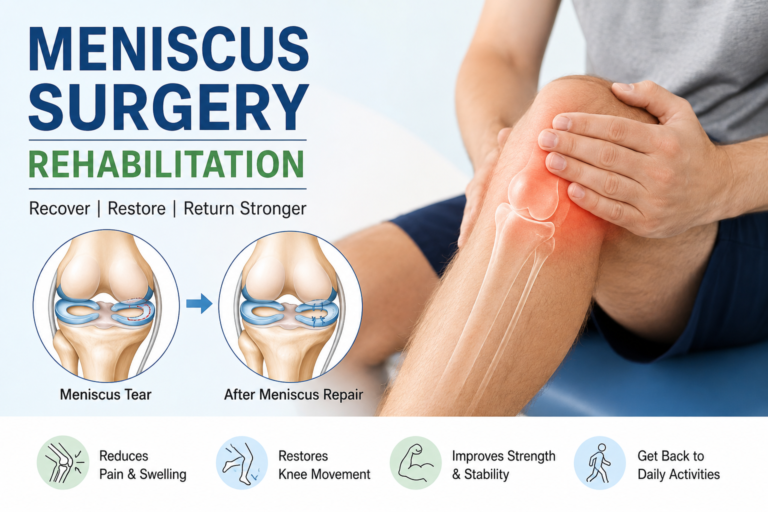
Meniscus surgery rehabilitation is a structured physiotherapy program designed to help patients recover safely after meniscus repair surgery or partial meniscectomy. The meniscus is a C-shaped cartilage inside the knee that acts as a shock absorber and provides stability. After surgery, physiotherapy is essential to reduce pain and swelling, restore knee movement, rebuild muscle strength, improve balance, and help patients return to walking, sports, and daily activities without complications.
At Indu Physiotherapy Clinic in Gurgaon, we provide personalized rehabilitation programs for patients recovering from meniscus surgery using evidence-based physiotherapy techniques and progressive exercise protocols.
Recovery Goal
Reduce Pain & Swelling
Control inflammation and protect the healing knee.
Restore Knee Movement
Improve bending and straightening gradually.
Build Strength & Balance
Strengthen the quadriceps, hamstrings, glutes, and calf muscles.
Return to Daily Activities & Sports
Progress safely toward walking, climbing stairs, running, and sports when appropriate.
The meniscus is a crescent-shaped cartilage between the thigh bone (femur) and shin bone (tibia). Each knee has:
Medial Meniscus – Inner side of the knee.
Lateral Meniscus – Outer side of the knee.
| Function | Importance |
|---|---|
| Shock Absorption | Reduces impact during walking and running. |
| Joint Stability | Helps keep the knee stable during movement. |
| Load Distribution | Spreads body weight evenly across the knee. |
| Joint Protection | Protects cartilage from excessive wear. |
| Surgery Type | Rehabilitation Focus |
|---|---|
| Meniscus Repair | Protect repaired tissue and gradual weight-bearing. |
| Partial Meniscectomy | Earlier mobility and strengthening progression. |
| Meniscus Transplant | Longer rehabilitation with protection phase. |
Patients may experience:
Knee pain.
Swelling around the knee.
Difficulty bending or straightening the knee.
Weakness in the thigh muscles.
Stiffness after sitting.
Difficulty walking or climbing stairs.
Reduced balance and confidence while walking.
These symptoms usually improve with a structured physiotherapy rehabilitation program.
Meniscus Surgery │ ▼ Pain & Swelling Management │ ▼ Restore Knee Range of Motion │ ▼ Strengthening Quadriceps & Hamstrings │ ▼ Balance & Walking Training │ ▼ Functional Activities & Stair Training │ ▼ Return to Sports / Daily Activities
Reduce swelling.
Protect healing tissue.
Improve circulation.
Activate thigh muscles.
Cryotherapy (Ice Therapy)
Compression and elevation.
Gentle patella mobilization.
Ankle pump exercises.
Quadriceps activation exercises.
Assisted knee bending within safe limits.
| Exercise | Purpose |
|---|---|
| Ankle Pumps | Improve blood circulation. |
| Quadriceps Sets | Activate thigh muscles. |
| Straight Leg Raise | Strengthen quadriceps safely. |
| Heel Slides | Restore knee bending gradually. |
Improve knee flexion and extension.
Restore normal walking pattern.
Increase flexibility.
Range-of-motion exercises.
Gentle stretching.
Stationary cycling (when appropriate).
Gait training.
Scar tissue mobilization (if required).
Improve muscle strength.
Increase knee stability.
Enhance functional movement.
| Exercise | Benefit |
|---|---|
| Mini Squats | Build quadriceps strength. |
| Wall Slides | Improve knee control. |
| Step-Ups | Improve stair climbing ability. |
| Bridges | Strengthen glute muscles. |
| Hamstring Strengthening | Support knee stability. |
Improve balance.
Enhance coordination.
Return to daily activities.
Balance board exercises.
Single-leg standing.
Lunges.
Stair climbing.
Sit-to-stand training.
Walking drills.
For athletes recovering after meniscus surgery.
Return to sports safely.
Improve agility.
Prevent re-injury.
Agility ladder drills.
Jump training.
Running progression.
Plyometric exercises.
Cutting and pivoting drills.
| Stage | Exercises |
|---|---|
| Early Stage | Ankle pumps, quad sets, heel slides. |
| Intermediate Stage | Straight leg raise, bridges, cycling. |
| Strength Stage | Mini squats, wall slides, step-ups. |
| Advanced Stage | Lunges, balance training, resistance exercises. |
| Sports Stage | Jogging, agility, hopping, jumping. |
| Muscle Group | Role in Recovery |
|---|---|
| Quadriceps | Supports knee extension and stability. |
| Hamstrings | Protects knee during bending. |
| Gluteus Muscles | Improves hip and knee alignment. |
| Calf Muscles | Improves walking and balance. |
| Core Muscles | Enhances overall lower-limb control. |
Reduce pain and swelling.
Improve knee flexibility.
Restore normal walking.
Strengthen knee-supporting muscles.
Improve balance and coordination.
Prevent knee stiffness.
Reduce the risk of re-injury.
Return safely to work and sports.
| Do’s ✅ | Don’ts ❌ |
|---|---|
| Follow physiotherapist instructions. | Avoid twisting the knee early. |
| Perform home exercises daily. | Don’t squat deeply too soon. |
| Use ice after exercises if advised. | Avoid running before clearance. |
| Walk with proper support if prescribed. | Don’t ignore persistent swelling or pain. |
| Maintain a healthy body weight. | Avoid high-impact activities too early. |
When Can You Return to Activities?
| Activity | Typical Rehabilitation Timeline* |
|---|---|
| Walking Without Support | 2–6 weeks (depends on surgery type). |
| Driving | Usually after adequate strength and knee control. |
| Stair Climbing | 4–8 weeks. |
| Jogging | 3–4 months (if appropriate). |
| Sports | 4–6 months after clearance from your surgeon and physiotherapist. |
*Recovery timelines vary depending on the type of surgery, healing progress, age, and individual rehabilitation program.
Detailed knee assessment.
One-to-one physiotherapy sessions.
Pain and swelling management.
Range of motion restoration.
Progressive muscle strengthening.
Balance and gait training.
Sports-specific rehabilitation.
Home exercise guidance.
Home physiotherapy services in Gurgaon.
Our rehabilitation programs are designed to help patients recover safely, regain confidence, and return to their daily routine and sports activities.
Yes. Physiotherapy is an essential part of recovery to restore knee movement, strength, balance, and function.
Recovery typically ranges from 6 weeks to 6 months, depending on the type of surgery and individual healing.
Most patients begin walking with support as advised by their surgeon and physiotherapist, with progression based on healing.
Return to sports depends on knee strength, balance, movement quality, and medical clearance after completing rehabilitation.
Meniscus Surgery Rehabilitation is a step-by-step recovery program that helps reduce pain, improve knee mobility, strengthen muscles, restore balance, and safely return to daily activities and sports. A personalized physiotherapy plan ensures optimal healing and reduces the risk of future knee injuries.
Most oral emergencies relate to pain, bleeding, or thoracic pain and should be attended by a Physiotherapist.
We will send you a confirmation within 24 hours. Emergency? Call +91-9289 059 265
Most oral emergencies relate to pain, bleeding, or thoracic pain and should be attended by a Physiotherapist.