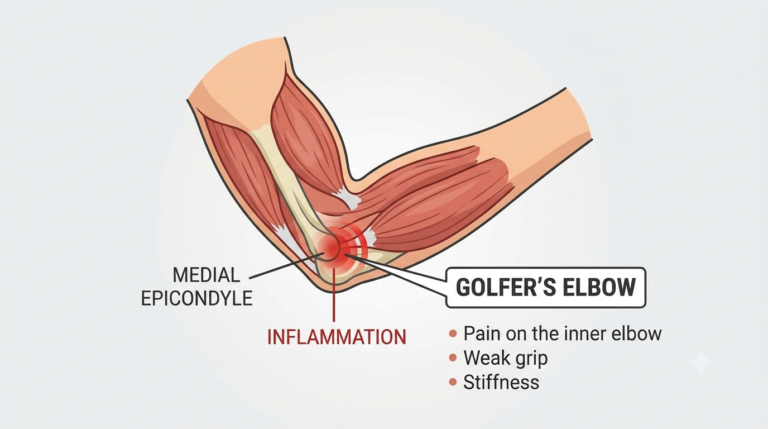
Golfer’s Elbow, medically known as Medial Epicondylitis, is a painful condition that affects the inner side of the elbow due to repetitive stress or overuse of the wrist and forearm muscles. It is common among golfers, badminton players, tennis players, gym enthusiasts, office professionals, plumbers, carpenters, and anyone who frequently performs gripping or lifting activities.
At Indu Physiotherapy Clinic in Gurgaon, we provide personalized Golfer’s Elbow Physiotherapy Treatment in Gurgaon using evidence-based rehabilitation techniques, manual therapy, dry needling, strengthening exercises, posture correction, and advanced pain management therapies to help patients recover naturally without surgery.
Golfer’s Elbow is an overuse injury where the tendons connecting the forearm muscles to the inside of the elbow become irritated or damaged. This causes pain, stiffness, and weakness while gripping, lifting, or twisting the wrist.
Golf swings
Racquet sports
Weightlifting
Typing and mouse use
Carrying heavy objects
Household chores
Step 1
Pain & Inflammation
Inner elbow pain, swelling, tenderness.
Step 2
Physiotherapy Assessment
Pain evaluation, muscle strength, grip strength, range of motion.
Step 3
Treatment Phase
Manual therapy, electrotherapy, dry needling, stretching, strengthening.
Step 4
Rehabilitation & Prevention
Grip strengthening, flexibility training, ergonomic correction, return to sports.
Patients experiencing Golfer’s Elbow may notice:
Pain on the inner side of the elbow.
Pain while gripping or shaking hands.
Weak grip strength.
Stiffness in the elbow joint.
Pain while lifting objects.
Wrist pain during bending.
Tingling or numbness extending into the forearm.
Early physiotherapy helps prevent chronic tendon damage.
Repetitive wrist flexion.
Repeated gripping activities.
Sports injuries.
Improper lifting technique.
Poor posture during computer work.
Heavy manual work.
Muscle imbalance and weak forearm muscles.
You may benefit from treatment if you are:
|
Profession / Activity |
Risk |
| Golfers & Racquet Players | Repetitive swings strain elbow tendons. |
| Gym Enthusiasts | Incorrect lifting technique causes tendon overload. |
| Office Professionals | Long hours of typing and mouse use increase forearm stress. |
| Manual Workers | Continuous gripping and lifting lead to tendon irritation. |
| Homemakers | Repetitive household work may trigger elbow pain. |
Physiotherapy is considered one of the safest non-surgical treatments for Golfer’s Elbow.
Pain relief without medication dependency.
Reduced tendon inflammation.
Improved grip strength.
Better flexibility of forearm muscles.
Faster recovery from sports injuries.
Prevention of recurring elbow pain.
Improved daily functional activities.
We assess:
Pain location.
Tendon irritation.
Grip strength.
Wrist flexibility.
Shoulder and neck posture.
Functional movement patterns.
Gentle hands-on techniques help:
Reduce muscle tightness.
Improve joint mobility.
Increase blood circulation.
Decrease pain.
Advanced modalities may include:
Ultrasound Therapy.
IFT Therapy.
TENS Therapy.
Laser Therapy.
These therapies help reduce pain and inflammation.
Dry Needling helps release trigger points and reduce chronic muscle tightness around the forearm and elbow.
Targeted stretches improve flexibility of:
Wrist flexors.
Forearm muscles.
Elbow tendons.
Shoulder muscles.
Progressive strengthening improves tendon healing and prevents recurrence.
1. Wrist Flexor Stretch
Hold for 20–30 seconds and repeat 3–5 times.
2. Wrist Curl Exercise
Use a light dumbbell and perform 10–15 repetitions.
3. Reverse Wrist Curl
Strengthens forearm extensor muscles.
4. Grip Strengthening Exercise
Squeeze a therapy ball for 10 seconds, repeating 10–15 times.
5. Forearm Pronation & Supination
Improves forearm strength and mobility.
|
Recovery Stage |
Expected Progress |
| Week 1–2 | Pain reduction and inflammation control. |
| Week 3–4 | Improved flexibility and grip strength. |
| Week 5–6 | Progressive strengthening exercises. |
| Week 6–8 | Return to sports and daily activities. |
Recovery varies depending on injury severity and treatment consistency.
Warm up before sports.
Stretch forearm muscles regularly.
Avoid repetitive gripping without breaks.
Improve workstation ergonomics.
Use proper sports technique.
Strengthen wrist and forearm muscles.
Avoid lifting heavy objects incorrectly.
Experienced Orthopedic Physiotherapists.
Personalized rehabilitation programs.
Sports injury physiotherapy.
Dry Needling Therapy.
Manual Therapy.
Electrotherapy.
Home Physiotherapy Services in Gurgaon.
Advanced pain management techniques.
We help patients recover safely and regain full elbow function.
Naturally include these keywords throughout your website:
Golfer’s Elbow Physiotherapy Treatment in Gurgaon
Best Physiotherapist for Golfer’s Elbow Gurgaon
Elbow Pain Physiotherapy Gurgaon
Medial Epicondylitis Treatment Gurgaon
Sports Physiotherapist Gurgaon
Physiotherapy Clinic Near Medanta Gurgaon
Elbow Tendon Rehabilitation Gurgaon
Forearm Pain Physiotherapy Gurgaon
Physiotherapist in Sector 46 Gurgaon
Home Physiotherapy for Elbow Pain Gurgaon
Yes. Physiotherapy helps reduce pain, improve tendon healing, restore grip strength, and prevent recurrence through targeted rehabilitation exercises and manual therapy.
Most patients recover within 6–8 weeks with regular physiotherapy, depending on the severity of the tendon injury.
Yes. Most cases improve with non-surgical treatments such as physiotherapy, exercise therapy, manual therapy, and activity modification.
Avoid repetitive gripping, heavy lifting, sudden sports activity, and exercises that increase elbow pain during the early recovery phase.
Yes. Indu Physiotherapy Clinic provides Golfer’s Elbow Physiotherapy Treatment near Medanta Hospital and across Gurgaon, including nearby sectors.
Most oral emergencies relate to pain, bleeding, or thoracic pain and should be attended by a Physiotherapist.
We will send you a confirmation within 24 hours. Emergency? Call +91-9289 059 265
Most oral emergencies relate to pain, bleeding, or thoracic pain and should be attended by a Physiotherapist.