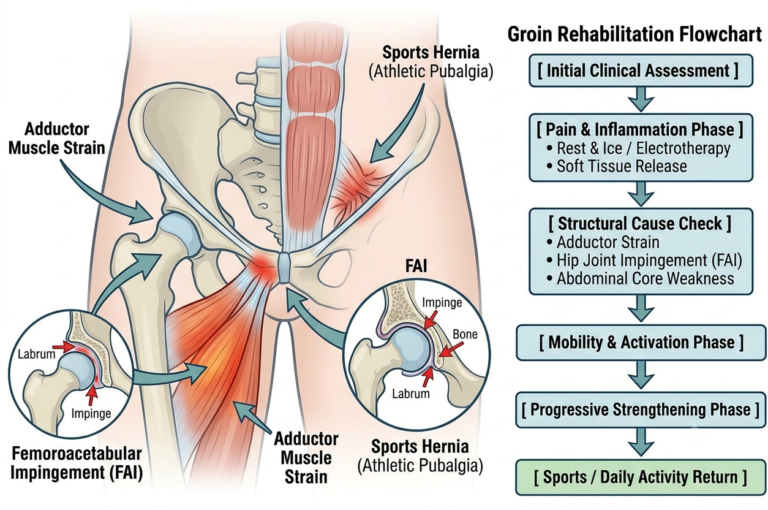
Groin pain is a common condition that affects athletes, active individuals, and adults experiencing hip joint issues. It typically presents as discomfort, sharpness, or aching in the inner thigh and pelvic fold area. At Indu Physiotherapy Clinic in Gurgaon, we offer evidence-based, customized assessment and physical therapy programs designed to treat the root cause of groin pain, improve movement, and restore full functional strength.
[ Initial Clinical Assessment ]
│
┌───────────────────────┴───────────────────────┐
▼ ▼
[ Pain & Inflammation Phase ] [ Structural Cause Check ]
• Rest & Ice / Electrotherapy • Adductor Strain
• Soft Tissue Release • Hip Joint Impingement (FAI)
│ • Abdominal Core Weakness
▼ │
[ Mobility & Activation Phase ] ◄─────────────────┘
• Dynamic Adductor Stretching
• Core & Glute Activation
• Pelvic Stability Training
│
▼
[ Progressive Strengthening Phase ]
• Copenhagen Adductor Exercises
• Hip Flexor & Eccentric Loading
• Functional Movement Patterns
│
▼
[ Sports / Daily Activity Return ]
• Agility & Change-of-Direction Drills
• Plyometrics & Load Progression
• Prevention & Maintenance Routine
Adductor Muscle Strain: Overstretching or tearing of the inner thigh muscles, frequent in sports with sudden changes of direction.
Adductor Tendonopathy: Chronic inflammation or degeneration of the tendons connecting inner thigh muscles to the pelvis.
Femoroacetabular Impingement (FAI): Structural impingement in the hip joint causing anterior hip and deep groin discomfort.
Hip Osteoarthritis: Degeneration of hip joint cartilage leading to stiffness and deep groin pain during weight-bearing.
Iliopsoas Bursitis / Strain: Inflammation or strain of the hip flexor tendon and bursa.
Sports Hernia (Athletic Pubalgia): Strain or tear of soft tissue in the lower abdomen or groin area.
Manual Therapy & Soft Tissue Release: Targeted hands-on techniques to release tight adductor muscles and relieve tension around the pubic symphysis.
Electrotherapy Modalities: TENS, IFT, or ultrasound therapy to modulate acute pain signals and accelerate tissue recovery.
Gentle Range of Motion (ROM): Dynamic hip flexor, adductor, and rotator stretches to prevent joint stiffness without overloading healing tissues.
Pelvic & Core Activation: Isometric exercises to engage the transverse abdominis, glutes, and pelvic floor for improved spinal and pelvic stability.
Copenhagen Adductor Protocol: Progressive eccentric adductor exercises proven to build strength and prevent re-injury.
Glute & Hip Abductor Strengthening: Lateral band walks, clamshells, and single-leg bridges to correct hip muscular imbalances.
Sport-Specific Movement Drills: Controlled running, side-stepping, and decelerating exercises tailored to your daily physical demands.
Home Maintenance Program: Customized stretching and strength routines to keep groin pain from recurring.
At Indu Physiotherapy Clinic, every patient receives a comprehensive physical assessment to isolate whether groin pain originates from muscle tendon strain, hip joint pathology, or pelvic instability.
We provide localized care across Gurgaon / Gurugram, servicing areas including Sector 46, Sector 45, Sector 47, Sector 38, Sector 39, Sector 40, Sector 49, Sector 50, Sector 51, Sector 52, Sohna Road, South City 2, Malibu Town, and near Medanta Hospital.
Mild adductor strains typically resolve within 2 to 4 weeks with early physiotherapy. Severe tendon injuries or chronic hip impingement may require 6 to 12 weeks of structured rehabilitation.
Aggressive stretching during acute injury can worsen muscle tears. Controlled isometric activation and dynamic movements supervised by a physiotherapist are recommended over heavy static stretching.
Yes. L2–L3 nerve root irritation in the lumbar spine can refer pain down into the groin area. Our assessment evaluates both the lower back and hip joint to ensure an accurate diagnosis.
Most oral emergencies relate to pain, bleeding, or thoracic pain and should be attended by a Physiotherapist.
We will send you a confirmation within 24 hours. Emergency? Call +91-9289 059 265
Most oral emergencies relate to pain, bleeding, or thoracic pain and should be attended by a Physiotherapist.