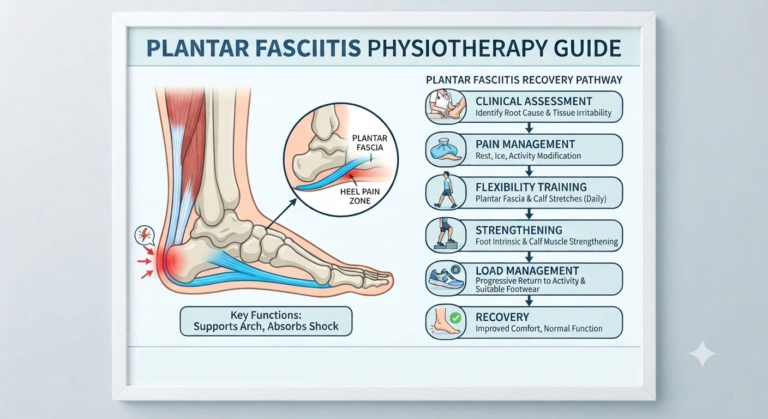
Plantar fasciitis is a condition involving pain and irritation of the plantar fascia, a thick connective tissue band that extends from the heel bone (calcaneus) towards the toes.
The plantar fascia supports the arch of the foot and helps absorb and distribute forces during standing, walking, running, and jumping.
Repeated loading, excessive mechanical stress, or inadequate recovery may contribute to plantar fascia irritation and heel pain.
The plantar fascia originates from the medial side of the calcaneus (heel bone) and extends towards the metatarsal heads near the toes.
Main functions of the plantar fascia:
Supports the medial longitudinal arch of the foot.
Helps maintain foot stability during walking.
Assists in distributing body weight.
Stores and releases elastic energy during walking and running.
Contributes to the windlass mechanism during toe-off.
TOES
/ |
/ |
Metatarsal Bones
| /
| /
PLANTAR FASCIA
=================
HEEL BONE
(Calcaneus)
Arch support and force distribution
During standing, walking, and running, the plantar fascia experiences repeated tensile loading.
When the loading exceeds the tissue’s capacity to adapt and recover, the plantar fascia may develop irritation, structural changes, and pain.
The condition is commonly associated with changes near the medial calcaneal attachment.
It is important to understand that persistent plantar fasciitis is not always simply an inflammatory condition. Degenerative and failed tissue-remodelling changes may also contribute.
Repeated Mechanical Loading
↓
Increased Stress on Plantar Fascia
↓
Reduced Tissue Recovery
↓
Irritation and Structural Changes
↓
Pain Near Heel Attachment
↓
Difficulty During Walking
↓
Reduced Functional Activity
Several factors may increase stress on the plantar fascia.
Standing for extended periods, particularly on hard surfaces, can increase repetitive loading on the heel and foot.
Rapidly increasing running distance, walking duration, or exercise intensity may overload the plantar fascia.
Reduced flexibility of the gastrocnemius and soleus muscles may affect ankle movement and increase stress during walking.
Excessive pronation, altered foot mechanics, or reduced foot muscle strength may contribute to plantar fascia loading in some individuals.
Shoes that are uncomfortable or provide inadequate support for an individual’s needs may aggravate symptoms.
Higher body weight may increase mechanical loading on the feet during standing and walking.
Activities involving repetitive jumping, sprinting, and running may increase plantar fascia loading.
Common symptoms include:
Sharp or stabbing pain near the bottom of the heel.
Pain during the first steps after waking up.
Discomfort after sitting for a prolonged period.
Increased heel pain after long periods of standing.
Pain during walking, running, or climbing stairs.
Tenderness near the inner side of the heel.
Stiffness around the heel and foot arch.
Typical symptom pattern: Pain may be worse during the first steps in the morning, improve temporarily with movement, and return after prolonged activity.
A physiotherapist performs an individualized assessment to identify contributing factors and understand the patient’s functional limitations.
The assessment may include:
Pain location and intensity.
Walking and standing pattern.
Ankle dorsiflexion range of motion.
Gastrocnemius and soleus flexibility.
Plantar fascia tenderness.
Foot posture and arch mechanics.
Foot and calf muscle strength.
Balance and functional mobility.
Footwear and activity history.
A clinical assessment is important because other conditions, including heel fat-pad problems, calcaneal stress injury, nerve entrapment, and referred pain, can also cause heel pain.
Treatment is selected according to pain severity, tissue irritability, foot mechanics, and activity requirements.
Purpose: Improve flexibility and reduce discomfort around the plantar fascia.
Technique:
Sit comfortably on a chair.
Place the affected foot over the opposite knee.
Hold the toes and gently pull them towards the shin.
Feel a gentle stretch along the sole of the foot.
Hold for approximately 15–30 seconds.
Repeat according to tolerance.
Purpose: Improve flexibility of the calf muscles and ankle movement.
Technique:
Stand facing a wall.
Place both hands against the wall.
Keep the affected leg behind you.
Keep the back heel on the floor.
Gently bend the front knee.
Feel a stretch in the back calf.
Both straight-knee and bent-knee calf stretches may be useful for targeting different calf muscles.
Purpose: Gently stretch the calf and plantar fascia.
Technique:
Sit with your legs extended.
Place a towel around the ball of the affected foot.
Gently pull the towel towards your body.
Keep the knee comfortably straight.
Hold for 15–30 seconds.
Purpose: Strengthen the small muscles of the foot.
Technique:
Sit on a chair.
Place a towel flat under your foot.
Use your toes to pull the towel towards you.
Relax and repeat.
Purpose: Improve intrinsic foot muscle activation and arch control.
Technique:
Sit or stand with your foot flat on the floor.
Gently draw the ball of the foot towards the heel.
Try to raise the arch without curling the toes.
Hold briefly and relax.
Purpose: Strengthen the calf muscles and improve lower-limb loading capacity.
Technique:
Stand while holding a stable support.
Slowly rise onto your toes.
Hold briefly.
Lower your heels in a controlled manner.
Progress according to pain tolerance and strength.
Purpose: Provide temporary soothing relief and gentle massage.
Technique:
Place a cold water bottle under the sole of your foot.
Roll it gently from the heel towards the forefoot.
Continue for a few minutes if comfortable.
Avoid applying excessive pressure.
Cold therapy may provide short-term symptom relief but does not replace strengthening and rehabilitation.
PLANTAR FASCIITIS
↓
Pain and Stiffness
↓
Initial Pain Management
↓
Plantar Fascia Stretching
↓
Calf Muscle Stretching
↓
Foot Muscle Strengthening
↓
Progressive Heel Raises
↓
Balance and Gait Training
↓
Return to Daily Activities
Depending on the patient’s condition, physiotherapy may include:
Therapeutic exercise and progressive loading.
Manual therapy for selected foot and ankle restrictions.
Taping techniques for short-term symptom support.
Footwear and activity modification.
Shockwave therapy when clinically appropriate.
Pain-relieving modalities as an adjunct when indicated.
Exercise-based rehabilitation and load management are important components of treatment. Passive modalities should not replace an appropriate strengthening programme.
Footwear can influence comfort and loading during daily activities.
Helpful recommendations may include:
Choose comfortable shoes with appropriate cushioning.
Consider suitable arch support if it improves comfort.
Avoid walking barefoot on hard floors if this aggravates symptoms.
Replace excessively worn-out footwear.
Select sports shoes according to your activity and foot requirements.
During painful periods, consider temporarily reducing:
Long-distance running.
Repeated jumping activities.
Prolonged standing on hard surfaces.
Sudden increases in walking distance.
High-impact exercise that increases heel pain.
Maintain comfortable activities where possible and gradually increase loading as symptoms improve.
Recovery differs from person to person. It depends on symptom duration, activity levels, contributing factors, treatment consistency, and the response of the plantar fascia to progressive loading.
Some people improve within weeks, while persistent cases may require several months of structured rehabilitation.
Consistency with exercise, suitable footwear, and activity modification can support recovery.
Consider professional assessment if you experience:
Heel pain that continues or repeatedly returns.
Difficulty walking comfortably.
Morning heel pain that affects daily activities.
Pain during standing or exercise.
Reduced ankle flexibility.
Persistent symptoms despite basic self-care.
Seek medical evaluation sooner for severe pain after an injury, inability to bear weight, marked swelling, redness, fever, or unexplained numbness.
Q1. What is the best exercise for plantar fasciitis?
Plantar fascia stretching, calf stretching, short foot exercises, and progressive heel raises are commonly used. The best combination depends on the patient’s assessment and tolerance.
Q2. Why does plantar fasciitis cause morning heel pain?
During sleep, the foot is usually relaxed. The first steps after waking suddenly load the plantar fascia, which may cause pain and stiffness.
Q3. Can physiotherapy cure plantar fasciitis?
Physiotherapy can help many patients manage pain, improve foot strength and flexibility, and restore walking function. Outcomes vary depending on individual factors.
Q4. Is walking good for plantar fasciitis?
Comfortable walking may be maintained, but excessive walking that significantly aggravates symptoms should be modified temporarily.
Q5. Is plantar fasciitis the same as a heel spur?
No. Plantar fasciitis involves irritation and structural changes of the plantar fascia. A heel spur is a bony projection near the heel and may be present without causing pain.
Q6. Can plantar fasciitis occur in both feet?
Yes. It can affect one or both feet, although symptoms may be different on each side.
Plantar fasciitis is a common cause of heel pain that can affect walking, standing, exercise, and daily activities. A structured physiotherapy programme involving plantar fascia stretching, calf flexibility, foot muscle strengthening, progressive loading, and appropriate footwear guidance can help improve function and support recovery.
Early assessment and consistent rehabilitation can help prevent persistent symptoms and restore comfortable movement.
Are you experiencing heel pain, morning foot stiffness, or difficulty walking due to plantar fasciitis?
At Indu Physiotherapy Center in Gurgaon, we provide individualized physiotherapy assessment, exercise-based rehabilitation, strengthening, mobility training, and guidance for heel pain management.
Most oral emergencies relate to pain, bleeding, or thoracic pain and should be attended by a Physiotherapist.
We will send you a confirmation within 24 hours. Emergency? Call +91-9289 059 265
Most oral emergencies relate to pain, bleeding, or thoracic pain and should be attended by a Physiotherapist.