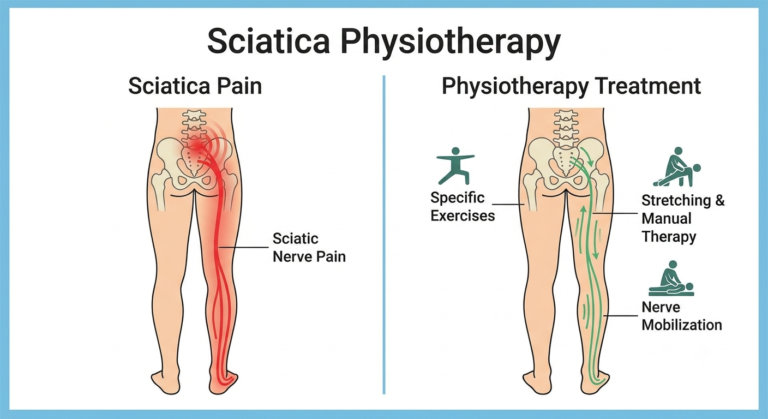
Sciatica is nerve pain caused by compression or irritation of the sciatic nerve. Instead of staying in the lower back, the pain travels down one leg along the path of the nerve.
The sciatic nerve starts in the lower spine, passes through the buttocks, and travels down each leg. Compression anywhere along this pathway can produce pain, numbness, tingling, or weakness.
|
Symptom |
Description |
| Lower Back Pain | Pain begins in the lumbar spine. |
| Leg Pain | Shooting pain travels from hip to foot. |
| Numbness | Loss of sensation in the leg or foot. |
| Tingling | Pins-and-needles sensation. |
| Muscle Weakness | Difficulty lifting the foot or walking. |
| Burning Pain | Sharp or electric shock-like pain. |
The sciatic nerve can become compressed in the lower back and send pain down the buttock, thigh, calf, and foot.
Several spinal and muscular conditions can compress the sciatic nerve.
|
Cause |
How It Causes Sciatica |
| Slipped Disc | Disc presses on the sciatic nerve. |
| Lumbar Disc Herniation | Nerve root compression. |
| Spinal Stenosis | Narrow spinal canal compresses nerves. |
| Piriformis Syndrome | Tight piriformis muscle irritates the sciatic nerve. |
| Degenerative Disc Disease | Age-related spinal changes. |
| Muscle Imbalance | Poor posture increases nerve irritation. |
People at higher risk include:
Office workers with prolonged sitting.
Drivers who sit for long hours.
Elderly individuals.
People with slipped discs.
Athletes with lower back injuries.
Individuals with obesity.
Workers performing heavy lifting.
Seek physiotherapy if you experience:
Pain radiating below the knee.
Tingling or numbness in the foot.
Difficulty walking.
Weakness in one leg.
Pain while sitting for long periods.
Pain during bending or lifting.
Rehabilitation progresses from assessment and pain relief to posture correction and return to daily activities.
Physiotherapy treats the root cause instead of only masking pain.
Reduce nerve compression.
Improve spinal mobility.
Strengthen supporting muscles.
Improve posture.
Reduce muscle tightness.
Prevent recurrence.
|
Physiotherapy Technique |
Benefit |
| Manual Therapy | Reduces joint stiffness and muscle tightness. |
| Neural Mobilization | Improves sciatic nerve movement. |
| Stretching Exercises | Reduces piriformis and hamstring tightness. |
| Core Strengthening | Supports the lumbar spine. |
| Postural Training | Corrects sitting and standing posture. |
| Electrotherapy | Helps reduce pain and inflammation. |
Relieves tightness around the sciatic nerve.
Improves lumbar flexibility.
Reduces tension on the sciatic nerve.
Helps centralize radiating pain.
Improves spinal stability.
Strengthens core and back muscles.
|
Muscle |
Role in Recovery |
| Transverse Abdominis | Stabilizes the lumbar spine. |
| Multifidus | Supports spinal joints. |
| Gluteus Maximus | Improves hip stability. |
| Gluteus Medius | Supports pelvic balance. |
| Hamstrings | Reduce nerve tension. |
| Hip Flexors | Improve mobility and posture. |
|
Exercise |
Duration |
| Piriformis Stretch | 20–30 seconds × 3 |
| Hamstring Stretch | 20–30 seconds × 3 |
| Knee-to-Chest | 10 repetitions |
| Cat-Camel Stretch | 10 repetitions |
| Cobra Stretch | 10 repetitions |
| Child’s Pose | 20 seconds × 3 |
Keep feet flat on the floor.
Support the lower back.
Keep knees at hip level.
Avoid prolonged sitting for more than 30–40 minutes.
Keep shoulders relaxed.
Maintain a neutral spine.
Avoid leaning on one leg.
Engage core muscles.
Heavy lifting.
Sudden twisting movements.
Long sitting without breaks.
High-impact running during acute pain.
Poor bending posture.
Sleeping on very soft mattresses.
Indu Physiotherapy Clinic provides Home Physiotherapy Services in Gurgaon for patients who cannot travel after severe pain or surgery.
Pain assessment.
Stretching program.
Strengthening exercises.
Walking training.
Ergonomic advice.
Progress monitoring.
|
Treatment |
Purpose |
| TENS Therapy | Pain relief. |
| Ultrasound Therapy | Reduces inflammation. |
| IFT Therapy | Controls muscle pain. |
| Dry Needling | Releases trigger points. |
| Myofascial Release | Reduces muscle tightness. |
| Kinesio Taping | Supports muscles and posture. |
|
Recovery Stage |
Expected Progress |
| Week 1 | Pain reduction and improved mobility. |
| Week 2–3 | Reduced leg pain and numbness. |
| Week 4–6 | Improved walking and strength. |
| Week 6–8 | Return to routine activities. |
| 2–3 Months | Better flexibility, posture, and long-term prevention. |
Recovery depends on the cause of sciatica, age, activity level, and consistency with exercises.
Personalized physiotherapy assessment.
Non-surgical sciatica rehabilitation.
Manual therapy and spinal mobilization.
Core strengthening program.
Gait and posture correction.
Home physiotherapy services in Gurgaon.
Experienced orthopedic and neuro physiotherapists.
We focus on identifying the root cause of sciatic nerve pain and providing long-lasting relief.
Yes. Many cases of sciatica improve significantly with physiotherapy, especially when caused by muscle tightness, posture problems, or mild disc irritation.
Most patients require 8–15 sessions, depending on the severity and underlying condition.
Yes, gentle walking is often beneficial, but it should be performed with correct posture and within pain limits.
Yes, if posture, core strength, and lifting techniques are not maintained. Physiotherapy helps reduce recurrence.
Yes. Indu Physiotherapy Clinic offers home physiotherapy services in Gurgaon for sciatica rehabilitation.
Sciatica Physiotherapy Treatment in Gurgaon is a safe, effective, and non-surgical solution for relieving lower back pain, leg pain, numbness, and nerve compression. With expert physiotherapy, stretching, strengthening exercises, posture correction, and manual therapy, patients can recover naturally and return to an active, pain-free lifestyle.
Most oral emergencies relate to pain, bleeding, or thoracic pain and should be attended by a Physiotherapist.
We will send you a confirmation within 24 hours. Emergency? Call +91-9289 059 265
Most oral emergencies relate to pain, bleeding, or thoracic pain and should be attended by a Physiotherapist.